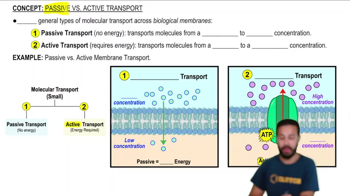
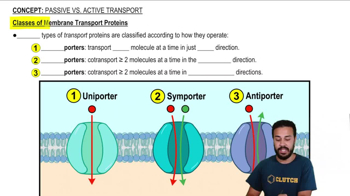
What distinguishes carrier proteins from channel proteins in membrane transport?
Carrier proteins undergo conformational changes to transport molecules across the membrane, while channel proteins form open pores allowing passive flow.
What is facilitated diffusion?
Passive movement of particles from high to low concentration across a membrane via protein channels or carrier proteins.
Name the three main cytoskeletal elements and their primary functions.
Microtubules: hollow tubes for cell shape and transport; Microfilaments: actin strands for shape and movement; Intermediate filaments: rope-like fibers for mechanical strength.
What is the main cation inside cells (ICF) and outside cells (ECF)?
Potassium (K⁺) is the main intracellular cation; Sodium (Na⁺) is the main extracellular cation.
List factors that increase the rate of diffusion according to Fick's Law.
How do hydrophobic and hydrophilic molecules differ in membrane permeability?
Hydrophobic (non-polar) molecules cross membranes more easily; Hydrophilic (polar or charged) molecules cross less easily.
What is osmosis?
Passive movement of water down its concentration gradient through lipid bilayer or aquaporins toward higher solute concentration.
Define osmotic pressure.
The pressure required to stop water movement by osmosis across a membrane.
What is the difference between osmolarity and tonicity?
Osmolarity measures total solute concentration in a solution; tonicity compares solute concentration between a solution and a cell affecting cell volume.
Describe isotonic, hypertonic, and hypotonic solutions in relation to cells.
Isotonic: no net water movement; Hypertonic: water leaves cell causing shrinkage; Hypotonic: water enters cell causing swelling.
What is the physiological saline concentration and its tonicity?
0.9% NaCl, approximately 278–310 mOsM, is isosmotic and isotonic to human cells.
What is exocytosis?
Active vesicular transport moving macromolecules out of the cell by vesicle fusion with the plasma membrane.
 Back
 03:41