 Back
Ch 9 Skeletal Muscle Tissue and Organization
 6:31

Terms in this set (20)
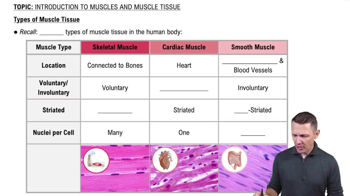
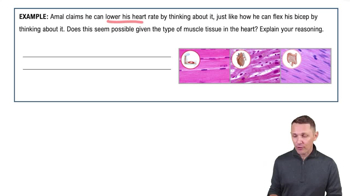
Skeletal muscle moves the body by pulling on bones, cardiac muscle pushes blood through the circulatory system, and smooth muscle moves fluids and solids through digestive and other systems.
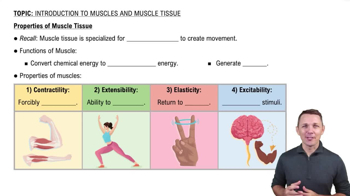
Excitability, contractility, extensibility, and elasticity.
Produce skeletal movement, maintain posture, support soft tissues, regulate material entry/exit, and maintain body temperature.
Epimysium surrounds the whole muscle, perimysium surrounds muscle fascicles, and endomysium surrounds individual muscle fibers.
A bundle of muscle fibers surrounded by perimysium.
A single muscle cell surrounded by endomysium and containing myofibrils.
The functional contractile unit of a myofibril, defined by the area between two Z lines.
Thick filaments (myosin), thin filaments (actin), Z lines, M line, H band, I band, and zone of overlap.
The H band and I band get smaller, the zone of overlap gets larger, Z lines move closer, and the A band stays the same width.
Calcium ions bind to troponin, causing tropomyosin to move and expose active sites on actin for myosin binding.
ATP is required for myosin heads to detach from actin and to power the contraction cycle.
The junction where a motor neuron communicates with a muscle fiber to initiate contraction.
Resting tension in skeletal muscles produced by continuous, low-level contraction of some motor units.
Increased mitochondria, glycolytic enzymes, glycogen reserves, and myofibrils, leading to muscle enlargement.
Large diameter, many myofibrils, large glycogen reserves, few mitochondria, fatigue easily, and contract quickly.
Smaller diameter, abundant mitochondria, use aerobic metabolism, rich capillary supply, contain myoglobin, and resist fatigue.
Fibers with properties between fast and slow fibers; contract speed faster than slow but slower than fast, more mitochondria, and greater fatigue resistance than fast fibers.
Origin is the stationary attachment point; insertion is the movable attachment point of a muscle.
Prime movers (agonists) produce a movement, synergists assist the prime mover, and antagonists oppose the prime mover.
First-class levers, second-class levers (force magnified), and third-class levers (speed and distance increased).