 Back
Ch.9 Part 3
 6:31

Terms in this set (22)
Force depends on number of cross bridges attached, influenced by: 1) Number of muscle fibers stimulated (recruitment), 2) Relative size of fibers, 3) Frequency of stimulation, 4) Degree of muscle stretch (80-120% optimal).
More motor units recruited leads to greater force of contraction due to increased number of muscle fibers activated.
Sarcomeres generate maximum force when stretched to 80-120% of resting length; less overlap or excessive stretch reduces force.
Three types: Slow oxidative (slow, aerobic), Fast oxidative (fast, aerobic), Fast glycolytic (fast, anaerobic glycolysis).
Slow ATPase activity, aerobic metabolism, high myoglobin, fatigue-resistant, suited for endurance and posture maintenance.
Fast ATPase activity, anaerobic glycolysis, low myoglobin, fatigable, suited for short-term intense movements like hitting a baseball.
Greater load decreases contraction velocity and shortens duration; muscles contract fastest with no load.
Increased recruitment of motor units results in faster and more prolonged muscle contractions.
Increased muscle capillaries, mitochondria, myoglobin; improves endurance, strength, fatigue resistance; may convert fast glycolytic to fast oxidative fibers.
Muscle hypertrophy due to fiber size increase, more mitochondria, myofilaments, glycogen, connective tissue; increases muscle strength and size.
Muscle degeneration from immobilization or loss of neural stimulation; strength declines rapidly; fibrous tissue replaces muscle; rehabilitation may become impossible.
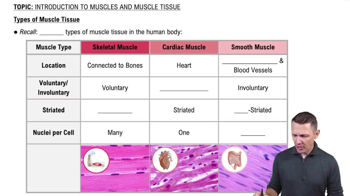
Found in walls of hollow organs (except heart); organized in sheets with longitudinal and circular layers oriented at right angles.
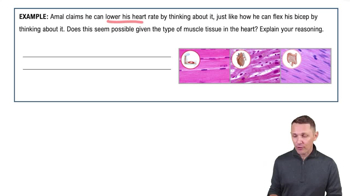
Smooth muscle fibers are spindle-shaped, single nucleus, no striations, lack connective tissue sheaths except endomysium, and have varicosities instead of neuromuscular junctions.
Varicosities are bulbous nerve swellings that release neurotransmitters into wide synaptic clefts (diffuse junctions) to innervate smooth muscle.
Calcium enters mainly from extracellular fluid via caveolae and voltage-gated channels; some Ca2+ released from sarcoplasmic reticulum.
Myofilaments arranged diagonally, thick filaments fewer with heads along length, no troponin but calmodulin binds Ca2+, intermediate filaments and dense bodies anchor filaments.
Ca2+ binds calmodulin, activating myosin light chain kinase, which phosphorylates myosin heads to enable cross bridge formation with actin.
Ca2+ detaches from calmodulin, Ca2+ actively transported out or into SR, and myosin is dephosphorylated to inactive form.
Contracts and relaxes slowly, maintains prolonged contraction with low energy cost due to slower ATPases and myofilament latch mechanism.
Controlled by nerves, hormones, and local chemicals; neurotransmitters can stimulate or inhibit depending on receptor type; some smooth muscle cells self-excitatory.
Smooth muscle briefly responds to stretch then adapts, allowing organs to store contents and maintain function over large volume changes.
Unitary (visceral) smooth muscle: electrically coupled, spontaneous action potentials; Multiunit smooth muscle: independent fibers, few gap junctions, controlled by autonomic nervous system.