 Back
chapter 10
 8:11

Terms in this set (14)
Axial muscles position and stabilize the head, neck, and trunk and assist breathing. Appendicular muscles move and stabilize limbs and girdles. Example: trapezius is appendicular.
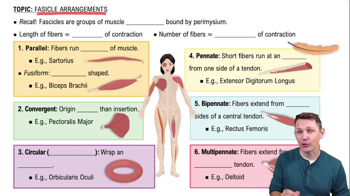
The four fascicle arrangements are parallel, convergent, pennate, and circular.
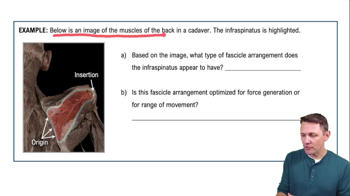
Pennate muscles fit more fibers in the same volume, producing more force but less excursion. Parallel muscles have less force but greater excursion.
Lever: rigid rotating bone. Fulcrum: joint. Effort: muscle force. Load: resistance.
Biceps curl is a third-class lever: fulcrum at elbow, effort by biceps, load is weight. Third class favors speed and range over force.
Origin: fixed end, usually proximal. Insertion: movable end. Action: movement produced by the muscle.
Agonist: prime mover (e.g., biceps). Antagonist: opposes agonist (e.g., triceps). Synergist: assists agonist (e.g., brachioradialis). Fixator: stabilizes joint or origin.
During extension, triceps becomes the agonist and biceps becomes the antagonist; their roles switch.
Rectus abdominis means straight muscle of the abdomen.
Orbicularis oris means circular muscle around the mouth.
Triceps brachii means three-headed muscle of the arm.
Extensor digitorum means muscle that extends the digits (fingers).
Flexor carpi radialis longus means long muscle that flexes the wrist on the radial (thumb) side.
Brevis: short; longus: long; maximus: largest; vastus: great; deltoid: triangular; transversus: across.