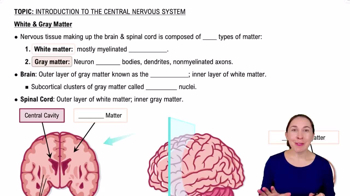
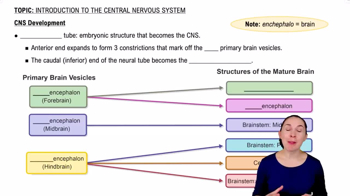
What are the main components of the nervous system?
Central Nervous System (CNS) and Peripheral Nervous System (PNS). CNS includes brain and spinal cord; PNS includes sensory (afferent) and motor (efferent) neurons.
What is the difference between sensory and motor neurons?
Sensory neurons carry signals from organs to CNS; motor neurons carry signals from CNS to muscles and glands.
What are the two main divisions of the autonomic nervous system?
Sympathetic division (fight or flight) and parasympathetic division (rest and digest).
What is the general pathway of autonomic efferent neurons?
A preganglionic neuron from CNS synapses in an autonomic ganglion with multiple postganglionic neurons that innervate target tissues.
How do the parasympathetic and sympathetic divisions differ in pre- and postganglionic neuron length?
Parasympathetic: long preganglionic, short postganglionic neurons. Sympathetic: short preganglionic, long postganglionic neurons.
What neurotransmitter and receptor are found at the pre- to postganglionic synapse in both autonomic divisions?
Acetylcholine (ACh) acting on nicotinic cholinergic receptors.
What neurotransmitters and receptors are found at the neuroeffector junction in the parasympathetic division?
ACh acting on muscarinic cholinergic receptors.
What neurotransmitters and receptors are found at the neuroeffector junction in the sympathetic division?
Mostly norepinephrine (NE) and epinephrine (E) acting on alpha and beta adrenergic receptors. Sweat glands use ACh with muscarinic receptors.
What is the role of the adrenal medulla in the sympathetic nervous system?
Acts as a modified ganglion; chromaffin cells release epinephrine into the blood as a neurohormone.
What is a varicosity in the autonomic nervous system?
Swollen regions along postganglionic axons that release neurotransmitter over a wide area of target tissue.
What are the main receptor subtypes for sympathetic adrenergic receptors?
 Back
 0:50