 Back
BackChapter 15
 4:28
4:28
Terms in this set (18)
Which of these structures contains the "voice box"?
trachea
pharynx
nasopharynx
larynx
larynx
Which of the following structures serves as a passageway for both food and air?
esophagus
pharynx
trachea
larynx
pharynx
The glottis is
the inferior margin of the soft palate.
a flap of elastic cartilage.
the cartilaginous part of the hard palate.
the passage from the pharynx to the larynx.
the opening to the pharynx.
the passage from the pharynx to the larynx.
Surfactant
plays a key role in keeping alveoli open.
is not found in healthy lung tissue.
replaces mucus in the alveoli.
is produced by pneumocytes type I.
phagocytizes dust or debris.
plays a key role in keeping alveoli open
Pulmonary ventilation refers to movement of dissolved gases from the blood to the interstitial space.
the utilization of oxygen.
the movement of dissolved gases from the alveoli to the blood.
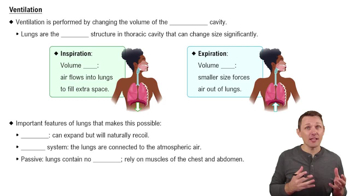
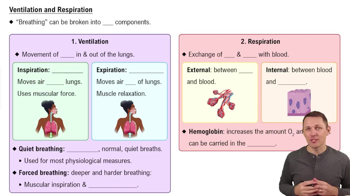
the movement of air into and out of the lungs.
the movement of air into and out of the lungs
Which of the lung volumes represents the amount of air you move into or out of your lungs during a single respiratory cycle?
total lung capacity
residual volume
vital capacity
tidal volume
tidal volume
Forced breathing during exhalation involves contraction of the internal intercostal muscles and the
scalenes.
external intercostals.
serratus anterior.
diaphragm.
abdominal muscles.
abdominal muscles
Which is defined as the amount of air that remains in the lungs after a maximum exhalation?
residual volume
inspiratory reserve volume
minimal volume
vital capacity
expiratory reserve volume
residual volume
Oxygen is transported in the blood __________.
bound to hemoglobin and dissolved in the blood plasma
as carbonic acid
only in a dissolved form in blood plasma
only in a bound form to hemoglobin
bound to hemoglobin and dissolved in the blood plasma
Respiratory rate is controlled involuntarily by the centers located in the __________.
medulla oblongata and pons
cerebral cortex
thalamus
hypothalamus
medulla oblongata and pons
What is the name of the structure vital for sound production?
larynx
trachea
lungs
bronchi
larynx
What is the name of the molecule that cells use for energy?
ATP
ADP
AMP
cAMP
ATP
what is the name of the group of molecules that "help" reactions to occur?
buffers
nutrients
enzymes
electrolytes
enzymes
How many oxygen molecules can a hemoglobin molecule carry when fully saturated?
one
two
three
four
four
Where is the respiratory mucosa found in the respiratory tract?
alveoli
conducting portion
respiratory portion
lamina propria
conducting portion
Where does gas exchange occur in the lungs during external respiration?
alveoli
conchae
bronchi
trachea
alveoli
What structure in the upper respiratory system traps pathogens?
Larynx
Capillaries in the lungs
Mucous membrane
Olfactory receptors
mucous membrane
Which of the following organ systems are directly involved in breathing air in and out?
Muscular system
Skeletal system
Nervous system
Endocrine system
muscular system