 Back
Chemistry of Life - Anatomy & Physiology
 03:35

Terms in this set (20)
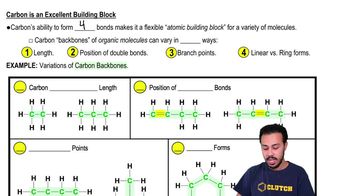
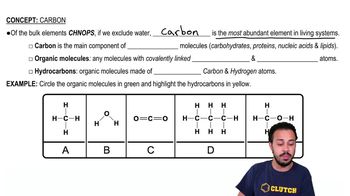
An organic compound contains carbon atoms bonded to hydrogen. Carbon is important because it can form four covalent bonds, allowing complex and diverse molecules essential for life.
A monomer is a small, basic molecular unit. A polymer is a large molecule made by linking many monomers together.
Dehydration synthesis is a chemical reaction that joins monomers by removing a water molecule, forming a polymer.
Hydrolysis is a chemical reaction that breaks polymers into monomers by adding a water molecule.
The four major classes are carbohydrates, lipids, proteins, and nucleic acids.
The monomers of carbohydrates are monosaccharides, such as glucose.
Carbohydrates are composed of carbon, hydrogen, and oxygen, usually in a ratio of 1:2:1, forming rings or chains of monosaccharides.
Examples include glucose and glycogen. They provide energy and serve as energy storage.
Lipids are not true polymers but are made of glycerol and fatty acids.
Lipids consist of a glycerol backbone bonded to fatty acid chains; they are hydrophobic molecules.
Examples include triglycerides, phospholipids, and steroids. Functions include energy storage, forming cell membranes, and hormone production.
The monomers of proteins are amino acids.
Proteins are polymers of amino acids linked by peptide bonds, folding into complex 3D shapes.
Examples include enzymes, antibodies, and hemoglobin. Functions include catalysis, immune defense, and oxygen transport.
The monomers of nucleic acids are nucleotides.
Nucleic acids are polymers of nucleotides, each containing a sugar, phosphate group, and nitrogenous base.
Examples include DNA and RNA. They store and transmit genetic information.
Proteins function as enzymes, structural components, transporters, signaling molecules, and immune defenders.
ATP (adenosine triphosphate) consists of adenine, ribose sugar, and three phosphate groups.
ATP provides energy for cellular processes by releasing energy when its phosphate bonds are broken.