Back

Connective, Muscle & Nervous Tissue - Anatomy & Physiology
Control buttons has been changed to "navigation" mode.
1/27
  • What are the main components of connective tissue? (made of)


    Connective tissue consists of cells, protein fibers, and ground substance, which together form the extracellular matrix.
  • What are the major roles of connective tissue?

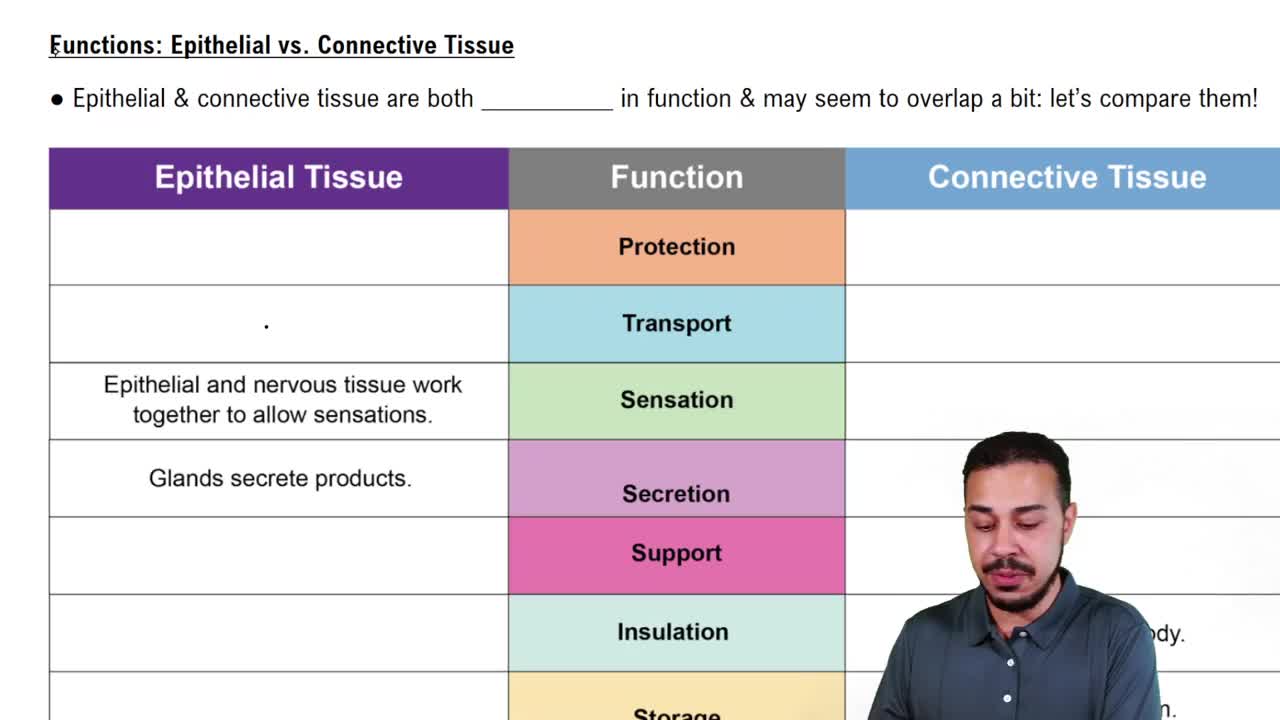
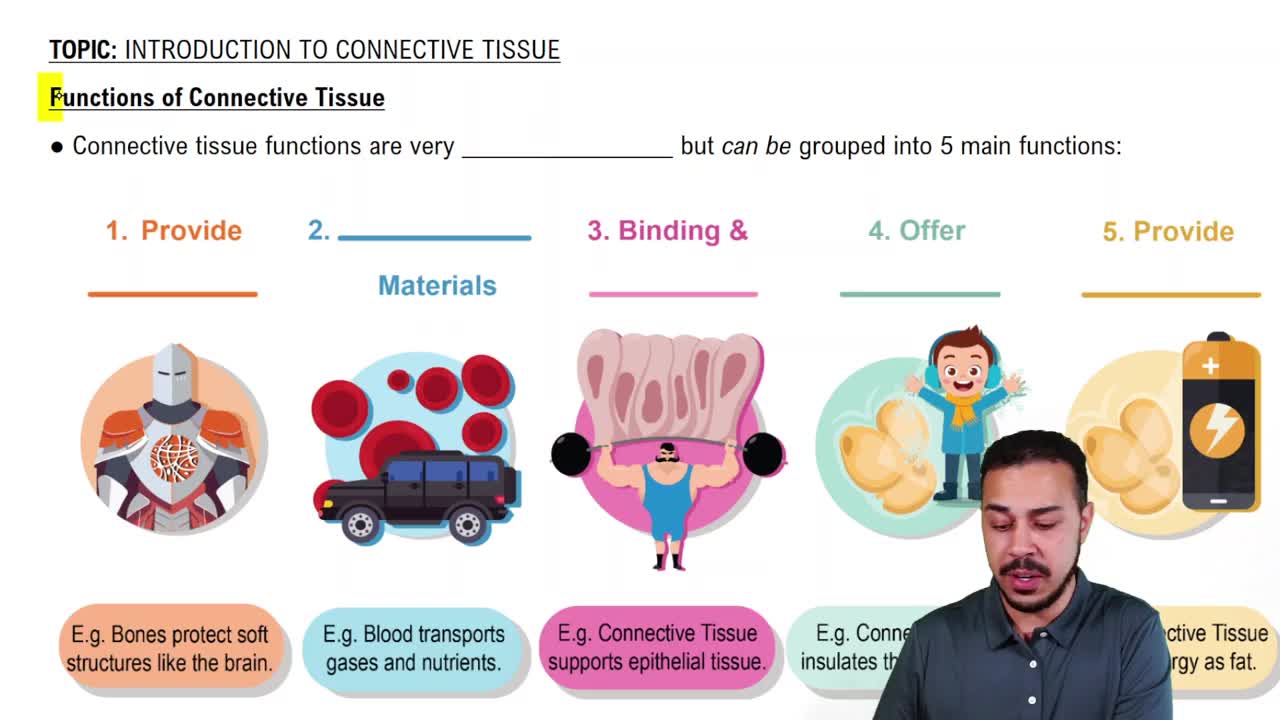
    Connective tissue functions in binding/support, protection, insulation, energy storage, and transport.
  • Name the three main categories of connective tissue.

    Connective tissue proper, supporting connective tissue, and fluid connective tissue.
  • What types of tissues are included in connective tissue proper?

    Areolar, adipose, reticular, dense regular, dense irregular connective tissues.
  • What is the primary function of connective tissue proper?

    Provides binding, support, packing, and elastic strength.
  • What tissues make up supporting connective tissue?

    Cartilage and bone.
  • What are the main functions of supporting connective tissue?

    Provides framework and protection.
  • What are the two types of fluid connective tissue?

    Blood and lymph.
  • What is the function of fluid connective tissue?

    Transport and defense.
  • Describe the structure and function of areolar connective tissue.

    Loose fibers that wrap and cushion organs and hold tissue fluid.
  • Where is areolar connective tissue found?

    Under epithelia and around vessels and organs. beneath the dermis of the skin, around blood vessels and nerves, and underneath the epithelial linings of the digestive, respiratory, and urinary systems

  • What is the main characteristic of adipose tissue?

    Large lipid-filled cells used for insulation, energy storage, and cushioning. (fat)

  • Where is adipose tissue commonly located?

    Subcutaneous tissue and around organs.Packed around internal organs in the abdominal cavity, such as the kidneys, heart (pericardium), and liver.

  • What is the function of reticular connective tissue?

    Supports cells with a network of reticular fibers.
  • Where is reticular connective tissue found?

    Lymph nodes, spleen, and bone marrow.
  • How are fibers arranged in dense regular connective tissue?

    Parallel collagen fibers close knot( think dense)

  • What is the function of dense regular connective tissue?

    Provides strong tension resistance in one direction; found in tendons and ligaments.
  • Describe dense irregular connective tissue fiber arrangement.

    Irregularly arranged collagen bundles. ( looks like marble)

  • What is the function of dense irregular connective tissue?

    Provides strength in many directions; found in dermis and fibrous capsules. found in muscle and digestive tra, liver, spleen, lymph nodes

  • What characterizes elastic connective tissue?

    Many elastic fibers that allow stretch and recoil. (aorta, lung, spine ,bladder)

  • Where is elastic connective tissue found?

    Walls of large arteries and some ligaments.
  • What is fascia in connective tissue?

    Connective tissue that surrounds, separates, and supports muscles, organs, nerves, and blood vessels.
  • Compare the matrix of cartilage and bone.

    Cartilage matrix is firm but flexible; bone matrix is hard and mineralized.
  • How does blood supply differ between cartilage and bone?

    Cartilage is avascular with nutrients diffusing; bone is vascular.
  • What cells are found in cartilage and bone?

    Cartilage contains chondrocytes in lacunae; bone contains osteocytes in lacunae.
  • What are the main functions of cartilage?

    Support, cushioning, and flexible framework.
  • What are the main functions of bone?

    Support, protection, mineral storage, and blood cell formation.