Skip to main content
Anatomy & Physiology
My Course
Learn
Exam Prep
AI Tutor
Study Guides
Textbook Solutions
Flashcards
Explore
Try the app
My Course
Learn
Exam Prep
AI Tutor
Study Guides
Textbook Solutions
Flashcards
Explore
Try the app
Back
Connective Tissue - Anatomy & Physiology
You can tap to flip the card.
What are the three basic components of connective tissue?
You can tap to flip the card.
👆
What are the three basic components of connective tissue?
Specialized cells
,
extracellular protein fibers
, and
fluid (ground substance)
.
Track progress
Control buttons has been changed to "navigation" mode.
1/20
Recommended videos
Guided course
06:37
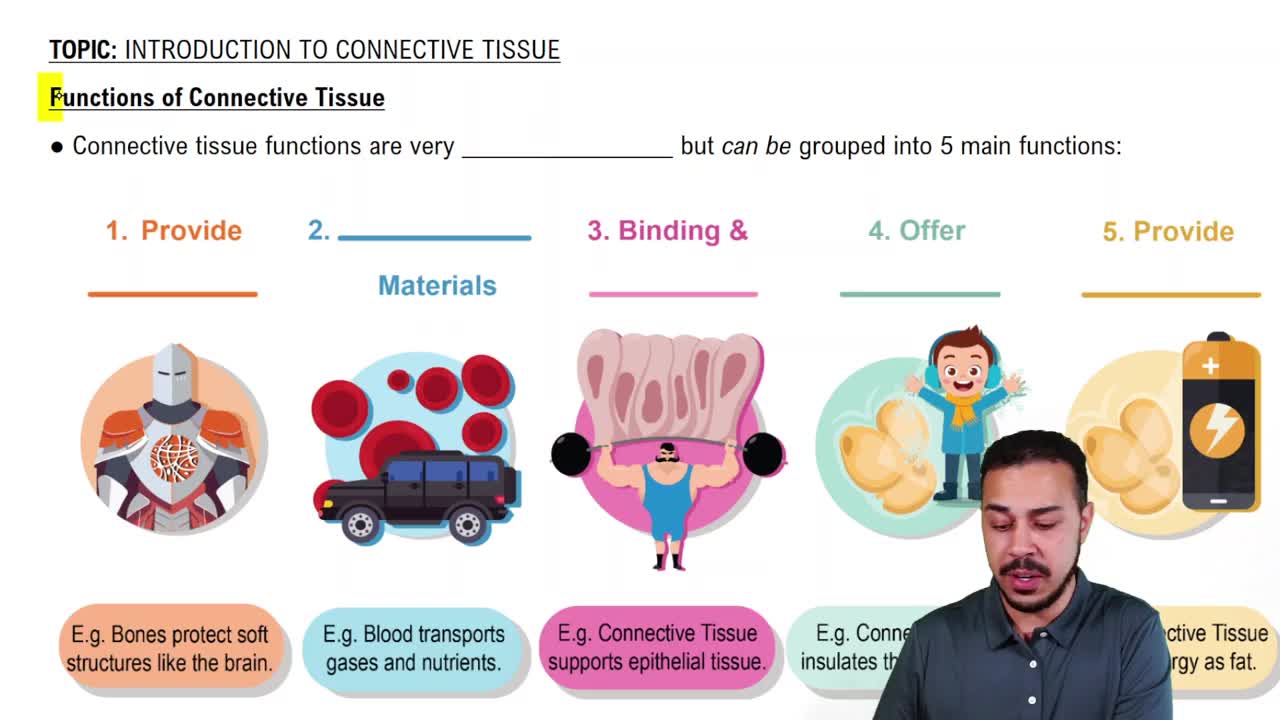
Functions of Connective Tissue
8180
views
137
rank
Guided course
08:54
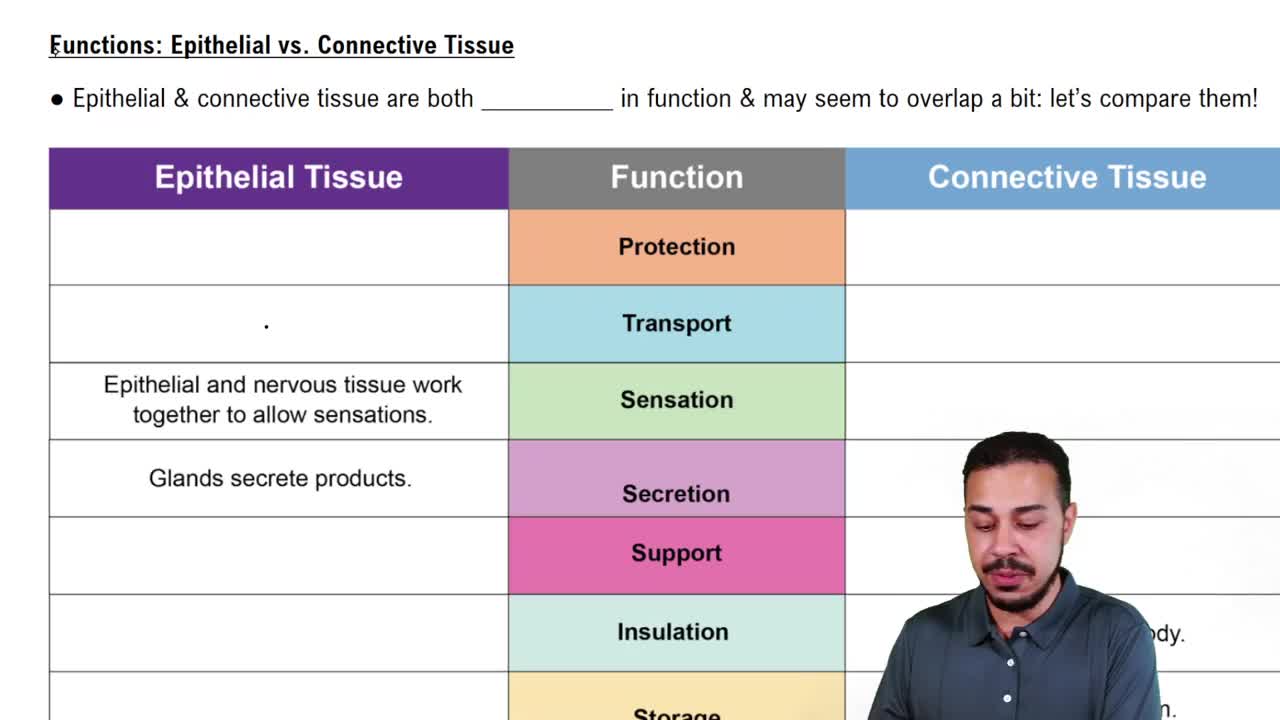
Functions: Epithelial vs. Connective Tissue
7724
views
120
rank
3
comments
Guided course
01:32
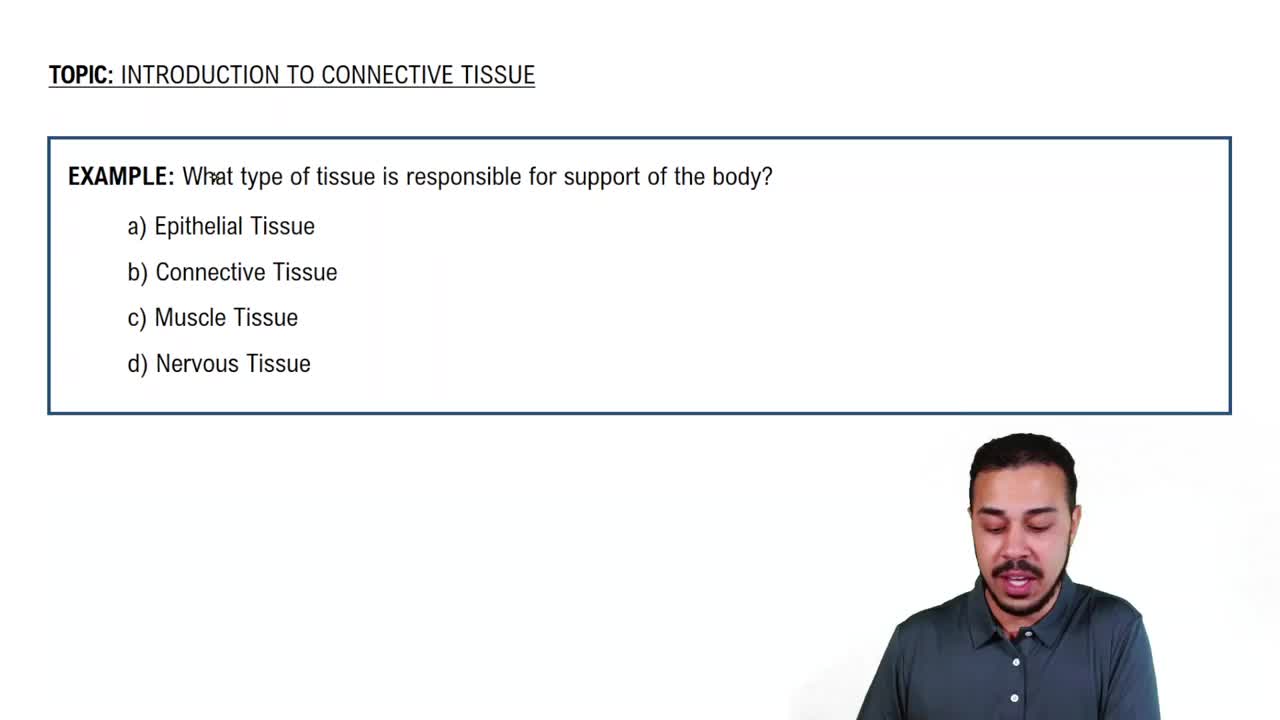
Introduction to Connective Tissue Example 1
6472
views
65
rank
1
comments
Terms in this set (20)
Hide definitions
What are the three basic components of connective tissue?
Specialized cells
,
extracellular protein fibers
, and
fluid (ground substance)
.
What is the main function of connective tissue?
Provides
structural framework
,
transport
,
protection
of organs,
support
,
connection
of other tissues, and
energy storage
.
Name the three types of connective tissue based on structure.
Connective tissue proper
,
fluid connective tissues
, and
supporting connective tissue
.
What characterizes fluid connective tissues?
They have a
watery matrix
with suspended proteins and usually minimal or no fibers, e.g., blood and lymph.
What is the composition of bone (osseous) tissue matrix?
Mostly calcium phosphate and some calcium carbonate (about 2/3 of matrix), with many collagen fibers for flexibility.
What are the main fiber types found in connective tissue?
Collagen
(strong tensile strength),
elastin
(elasticity), and
reticular fibers
(supportive network).
What is the role of fibroblast cells in connective tissue?
They produce the
fibers
and
ground substance
of the extracellular matrix.
What distinguishes fixed cells from wandering cells in connective tissue?
Fixed cells are embedded in dense ground substance and maintain tissue, while wandering cells move and function in defense and repair.
Name the three types of loose connective tissue.
Areolar
(most common, packing material),
adipose
(fat storage), and
reticular
(supportive framework in organs).
What are the three types of dense connective tissue?
Dense regular
(parallel collagen fibers),
dense irregular
(random collagen fibers), and
elastic
(more elastic fibers).
What is the matrix composition of cartilage?
A firm gel containing polysaccharide derivatives called
chondroitin sulfates
combined with proteins to form proteoglycans.
What are the three types of cartilage?
Hyaline
,
elastic
, and
fibrous
cartilage.
Where is hyaline cartilage found and what is its function?
Between ribs and sternum, covering bones in joints, and respiratory system; provides
stiff but flexible support
and reduces friction.
What is the main characteristic of elastic cartilage?
Supports structures like the external ear with
increased flexibility
due to more elastic fibers.
What is the function of fibrous cartilage?
Resists compression, prevents bone-to-bone contact, and limits movement; found in knee joints, pubic bones, and intervertebral discs.
What is the function of reticular fibers in connective tissue?
They form a
supportive network
for cells in organs like bone marrow, spleen, and lymph nodes.
What is the ground substance in connective tissue proper composed of?
A viscous, clear substance due to
glycoproteins
and
proteoglycans
.
What are the main cell types in connective tissue proper?
Fixed cells (e.g., melanocytes, mast cells, adipocytes) and wandering cells (e.g., lymphocytes, plasma cells, neutrophils).
What is the significance of collagen fibers in connective tissue?
They have a tensile strength stronger than steel and provide
structural support
.
What is the difference between dense regular and dense irregular connective tissue?
Dense regular has parallel collagen fibers for strength in one direction; dense irregular has random fibers for strength in multiple directions.
 BackBack
 06:37