 Back
BackConnective Tissue and Membranes in Anatomy & Physiology
 06:37
06:37

Terms in this set (20)
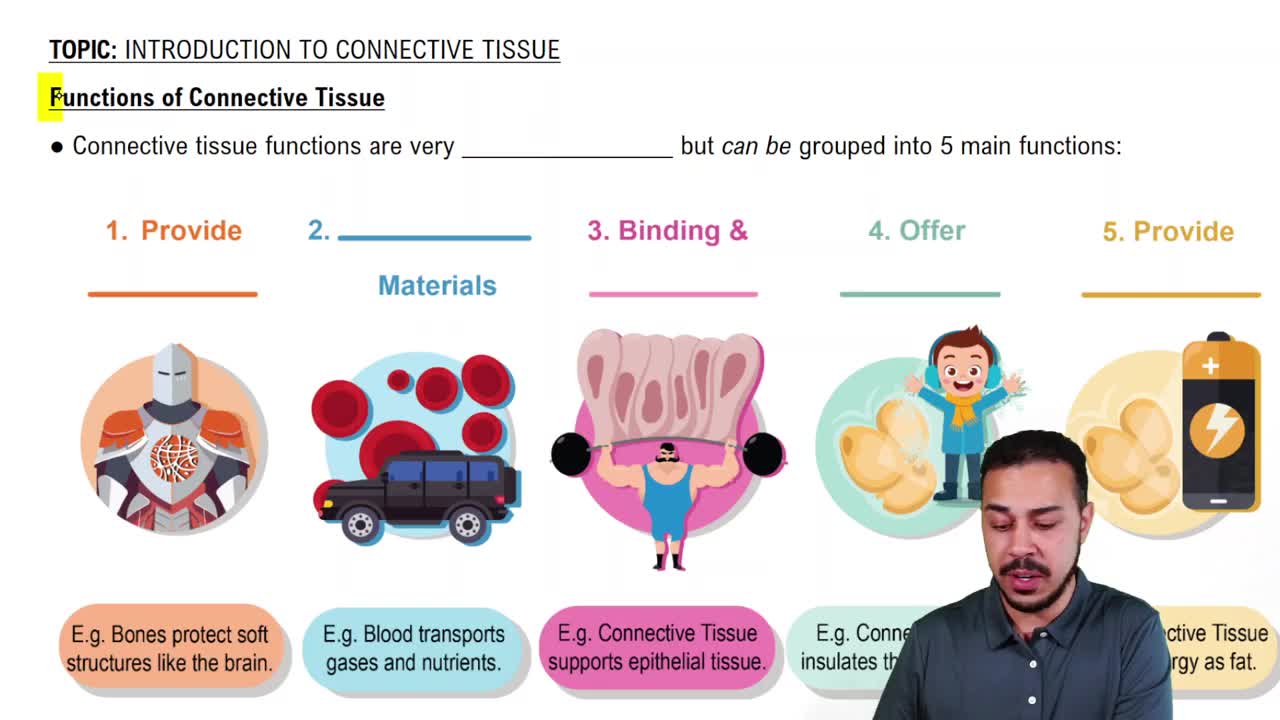
Connective tissue is classified into three broad categories: connective tissue proper, supportive connective tissue, and fluid connective tissue.
The main protein fibers are collagen fibers (strong, resist force in one direction), reticular fibers (network, resist force in many directions), and elastic fibers (branched, return to original length after stretching).
The extracellular matrix consists of protein fibers and a fluid called ground substance, which varies depending on the connective tissue type.
Mesenchyme is an embryonic connective tissue with multipotent mesenchymal cells; it is the common origin for all other connective tissues.
Areolar tissue is a loose connective tissue with elastic fibers, collagen fibers, fibroblasts, and ground substance; it supports and cushions organs.
Adipose tissue contains adipocytes that store fat, providing insulation, energy storage, and cushioning.
Dense regular connective tissue has parallel collagen fibers providing strength in one direction, found in tendons and ligaments.
Dense irregular connective tissue has collagen fibers in multiple directions, providing strength against forces from many directions, found in dermis and organ capsules.
Elastic connective tissue contains many elastic fibers allowing tissues to stretch and recoil, such as in elastic ligaments and large arteries.
Cartilage provides support, shock absorption, and protection, with a gel-like matrix and chondrocytes in lacunae.
Hyaline: most common, weakest, found in fetal skeleton and joints.
Elastic: elastic fibers, flexible, found in ear and epiglottis.
Fibrocartilage: dense collagen, very durable, found in intervertebral discs and menisci.
The periosteum is the tissue covering bone surface, with a fibrous outer layer and a cellular inner layer for growth and repair.
Bone matrix is calcified with calcium salts and contains collagen fibers for flexibility.
Osteocytes are mature bone cells located in lacunae arranged around central canals within the bone matrix.
The four types are mucous membranes, serous membranes, cutaneous membrane, and synovial membranes.
Mucous membranes line passageways with external connections, keeping surfaces moist to reduce friction and facilitate absorption and excretion.
Serous membranes line cavities not open to the outside, are thin but strong, and produce fluid to reduce friction between organs and cavity walls.
The cutaneous membrane is the skin, characterized as thick, waterproof, and dry.
Synovial membranes line joint cavities, produce synovial fluid for lubrication, and protect bone ends; they lack a true epithelium.
Neural tissue contains neurons (nerve cells) and neuroglia (supporting cells that repair and supply nutrients).