 Back
BackDigestive System - Anatomy & Physiology
 4:06
4:06
Terms in this set (29)
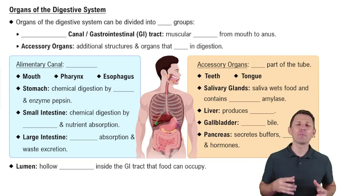
The muscular tube through which food passes, starting at the mouth and ending at the anus.
Salivary glands, liver, gallbladder, and pancreas that produce secretions to aid digestion.
Mucosa, submucosa, muscularis externa, and serosa or adventitia.
Epithelium, lamina propria, and muscularis mucosae.
Stratified squamous in oral cavity, pharynx, upper esophagus, rectum; simple columnar in lower esophagus, stomach, intestines.
Two smooth muscle layers (circular and longitudinal) responsible for mechanical processing and propulsion of food.
Myenteric plexus controls motility; submucosal plexus regulates secretions and responds to food presence.
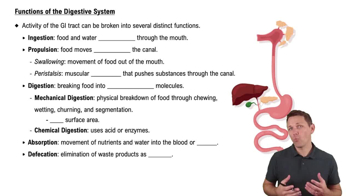
Ingestion, mechanical processing, propulsion, chemical digestion, secretion, absorption, and compaction.
Gastrin, secretin, cholecystokinin (CCK), and gastric inhibitory peptide (GIP).
Circumvallate, fungiform, and foliate papillae contain taste buds; filiform papillae do not.
Moistens food, cleanses mouth, dissolves chemicals for taste, and begins digestion of carbohydrates and fats.
Incisors cut, canines tear, premolars and molars grind and crush food.
Nasopharynx (air only), oropharynx and laryngopharynx (food and air passage, lined with stratified squamous epithelium).
Upper third skeletal muscle, middle third mixed, lower two-thirds smooth muscle for peristalsis.
Cardiac, fundus, body, and pyloric regions.
Chief cells secrete pepsinogen, parietal cells secrete HCl and intrinsic factor, G cells secrete gastrin and other hormones.
Duodenum, jejunum, and ileum.
Increase surface area for absorption in the small intestine.
Enzymes like aminopeptidase and maltase that complete digestion of peptides and carbohydrates.
Reabsorbs water, absorbs vitamins from bacteria, and stores fecal material.
Filters nutrient-rich blood, regulates cholesterol, removes toxins, and produces bile for fat emulsification.
Sodium bicarbonate, pancreatic proteases, amylase, lipases, and nucleases.
Stores and concentrates bile, releasing it into the duodenum when stimulated by CCK.
Formed by the union of the common hepatic duct and cystic duct; drains bile into the duodenum.
Buccal (voluntary), pharyngeal (involuntary), and esophageal (involuntary) phases of swallowing.
Tooth enamel erosion caused by bacterial plaque leading to cavities.
Chronic acid reflux due to failure of the cardiac sphincter to prevent stomach acid backflow.
Specialized macrophages that remove debris and bacteria from blood.
Pocket-like sacs formed by teniae coli that allow expansion and elongation of the colon.