 Back
Digestive System and Metabolism - Anatomy & Physiology
 4:06

Terms in this set (30)
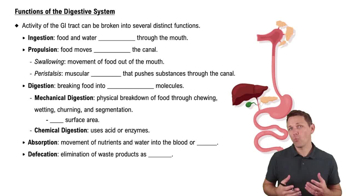
Functions of the digestive system
Ingestion, digestion, absorption, and elimination of food and nutrients.
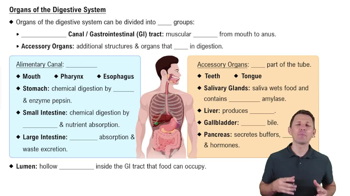
Includes the mouth, esophagus, stomach, small intestine, large intestine, rectum, and anus.
Salivary glands, liver, gallbladder, and pancreas assist digestion but are not part of the alimentary canal.
Include gastrin, secretin, cholecystokinin (CCK), and gastric inhibitory peptide (GIP), which regulate digestive processes.
Include parietal cells (secrete HCl), chief cells (secrete pepsinogen), and mucous cells (secrete mucus).
Involves the enteric nervous system and autonomic nervous system controlling motility and secretion.
Includes peristalsis (wave-like muscle contractions) and segmentation (mixing movements).
Features villi and microvilli that increase surface area for absorption.
Commensal bacteria that aid in fermentation, vitamin synthesis, and pathogen defense.
A spinal cord reflex that triggers relaxation of the internal anal sphincter and contraction of rectal muscles.
Liver cells responsible for metabolism, bile production, and detoxification.
Produce saliva containing amylase to begin carbohydrate digestion.
Diffuse neuroendocrine system cells in the digestive tract that secrete hormones regulating digestion.
All chemical reactions in the body, including catabolism (breakdown) and anabolism (synthesis).
Catabolism breaks down molecules to release energy; anabolism uses energy to build molecules.
Include glucose, fatty acids, and amino acids used in cellular respiration.
Breakdown of proteins into amino acids for energy or synthesis.
Process of breaking down glucose to produce ATP via glycolysis, citric acid cycle, and electron transport chain.
Reactions that require energy input to proceed.
Addition of a phosphate group to a molecule, often to activate or store energy.
Direct transfer of a phosphate group to ADP to form ATP during glycolysis and the citric acid cycle.
Reactions involving the transfer of electrons between molecules.
Occurs in the cytoplasm, requires glucose and NAD+, produces pyruvate, ATP, and NADH.
Occurs in the mitochondrial matrix, requires acetyl-CoA, produces CO2, NADH, FADH2, and ATP.
Located in the inner mitochondrial membrane, uses NADH and FADH2 to create a proton gradient for ATP synthesis.
Produced from fatty acid breakdown during fasting; can be used as an alternative energy source.
Waste product formed in the liver from amino acid deamination and excreted in urine.
Process of converting glucose to glycogen for storage in liver and muscle.
Formation of glucose from non-carbohydrate sources like amino acids and glycerol.
HDL transports cholesterol to the liver for removal; LDL delivers cholesterol to tissues and can contribute to plaque formation.