Skip to main content
Anatomy & Physiology
My Course
Learn
Exam Prep
AI Tutor
Study Guides
Textbook Solutions
Flashcards
Explore
Try the app
My Course
Learn
Exam Prep
AI Tutor
Study Guides
Textbook Solutions
Flashcards
Explore
Try the app
Back
Digestive System - Medical Terminology (unit2)chapter 11
You can tap to flip the card.
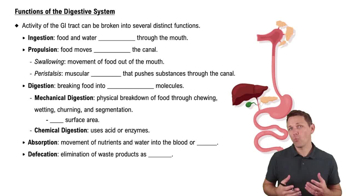
Function of the digestive system
You can tap to flip the card.
👆
Function of the digestive system
Responsible for ingesting and digesting food, absorbing nutrients, and eliminating waste products.
Track progress
Control buttons has been changed to "navigation" mode.
1/29
Recommended videos
Guided course
4:06
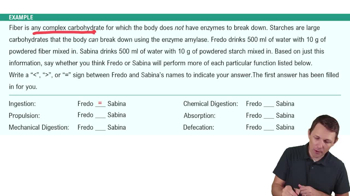
Introduction to the Digestive System Example 2
6647
views
116
rank
Guided course
5:08
Functions of the Digestive System
7526
views
156
rank
Guided course
6:28
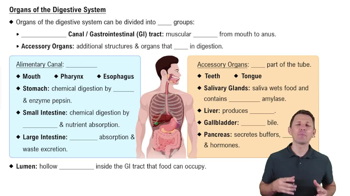
Organs of the Digestive System
11007
views
332
rank
1
comments
Terms in this set (29)
Hide definitions
Function of the digestive system
Responsible for ingesting and digesting food, absorbing nutrients, and eliminating waste products.
Flow of food through the GI tract
Mouth → Esophagus → Stomach → Small intestine → Large intestine → Rectum → Anus.
Role of the stomach in digestion
Muscular sac that produces hydrochloric acid and enzymes to assist with food digestion.
Function of the small intestine
Primary site for absorption of nutrients from digested food.
Function of the large intestine
Reabsorbs water and fluids, compacts waste into feces.
Accessory organs of the digestive system
Liver, gallbladder, and pancreas; assist digestion but are not part of the digestive tract.
Function of the liver
Metabolizes carbohydrates, proteins, and fats; produces bile for digestion.
Function of the gallbladder
Stores, concentrates, and releases bile.
Function of the pancreas
Produces enzymes that break down carbohydrates, proteins, and fats.
Meaning of suffix -itis
Indicates inflammation.
Meaning of suffix -ectomy
Surgical removal or excision.
Meaning of prefix a-
Without or absence of.
Ascites
Accumulation of fluid in the abdominal cavity.
Cirrhosis
Liver condition with fat infiltration and fibrous scarring causing permanent damage.
Cholecystitis
Inflammation of the gallbladder.
Cholecystolithiasis
Presence of stones in the gallbladder.
Diverticulosis
Formation of small pouches pushing outward through weak spots in the colon wall.
Diverticulitis
Inflammation and complications of diverticula in the colon.
Esophageal atresia
Congenital condition where the esophagus ends in a pouch and does not connect to the stomach.
Gastroesophageal reflux disease (GERD)
Stomach contents leak backward into the esophagus causing irritation.
Hepatitis
Inflammation of the liver caused by viral infections or toxins.
Ulcerative colitis
Chronic inflammatory bowel disease affecting the colon and rectum with ulcers and inflammation.
Barium enema
X-ray examination of the large intestine using barium as contrast.
Upper gastrointestinal series
X-ray examination of the esophagus and stomach using barium contrast.
Laparoscopy
Minimally invasive procedure to view inside the abdomen using a laparoscope.
Bariatric surgery
Surgical procedures to treat extreme obesity, such as gastric bypass.
Cholecystectomy
Surgical removal of the gallbladder.
Colostomy
Surgical creation of a new opening in the colon.
Pharmacological treatment for GERD
Use of antacids to reduce stomach acid and relieve symptoms.
 BackBack
 4:06