Skip to main content
Anatomy & Physiology
My Course
Learn
Exam Prep
AI Tutor
Study Guides
Textbook Solutions
Flashcards
Explore
Try the app
My Course
Learn
Exam Prep
AI Tutor
Study Guides
Textbook Solutions
Flashcards
Explore
Try the app
Back
Digestive System Structures and Functions
1 student found this helpful
You can tap to flip the card.
Hard palate
You can tap to flip the card.
👆
Hard palate
Forms the roof of the mouth and separates the oral and nasal cavities, aiding in chewing and swallowing.
Track progress
Control buttons has been changed to "navigation" mode.
1/28
Recommended videos
Guided course
4:06
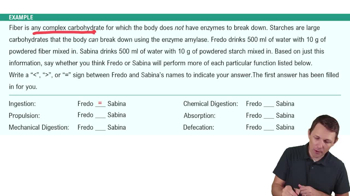
Introduction to the Digestive System Example 2
6647
views
116
rank
Guided course
5:08
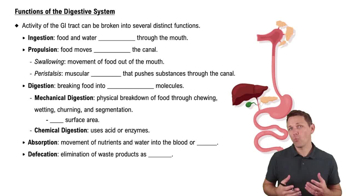
Functions of the Digestive System
7526
views
156
rank
Guided course
6:28
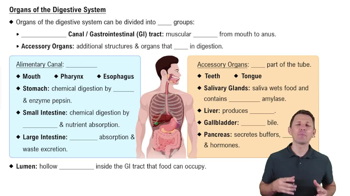
Organs of the Digestive System
11007
views
332
rank
1
comments
Terms in this set (28)
Hide definitions
Hard palate
Forms the roof of the mouth and separates the oral and nasal cavities, aiding in chewing and swallowing.
Soft palate
Separates the oropharynx from the nasopharynx and helps close the nasal passages during swallowing.
Tongue
Manipulates food for chewing and swallowing; contains taste buds and aids in speech.
Epiglottis
Prevents food from entering the trachea during swallowing by covering the glottis.
Esophagus
Transports food from the pharynx to the stomach via peristalsis.
Stomach
Secretes gastric juice containing enzymes like pepsin to digest proteins and churns food into chyme.
Pyloric sphincter
Controls the passage of chyme from the stomach into the duodenum.
Mesentery
Supports and suspends the intestines; contains blood vessels, nerves, and lymphatics.
Peritoneum
Serous membrane lining the abdominal cavity and covering abdominal organs.
Small intestine
Primary site of nutrient absorption; includes duodenum, jejunum, and ileum.
Duodenum
First part of the small intestine; receives chyme, bile, and pancreatic enzymes for digestion.
Jejunum
Middle section of the small intestine; major site of nutrient absorption.
Ileum
Final section of the small intestine; absorbs vitamin B12 and bile salts.
Pancreas
Produces digestive enzymes like amylase, lipase, and proteases; secretes bicarbonate to neutralize stomach acid.
Liver
Produces bile to emulsify fats and processes nutrients absorbed from the small intestine.
Gallbladder
Stores and concentrates bile, releasing it into the bile duct during digestion.
Bile duct
Transports bile from the liver and gallbladder to the duodenum.
Large intestine
Absorbs water and electrolytes; forms and stores feces.
Cecum
First part of the large intestine; receives chyme from the ileum.
Rectum
Stores feces before defecation.
Uvula
Prevents food from entering the nasal cavity during swallowing.
Oropharynx
Passageway for food from the mouth to the esophagus.
Laryngopharynx
Passageway directing food to the esophagus and air to the larynx.
Parotid gland
Salivary gland producing amylase-rich saliva; drains via the parotid duct.
Sublingual gland
Salivary gland producing mucus-rich saliva under the tongue.
Submandibular gland
Salivary gland producing a mix of serous and mucous saliva.
Rugae
Folds in the stomach lining that allow expansion and increase surface area.
Greater omentum
Fatty apron-like fold of peritoneum that covers abdominal organs and stores fat.
 BackBack
 4:06