 Back
BackEmbryonic Development and Structure of the Central Nervous System
 0:50
0:50
Terms in this set (21)
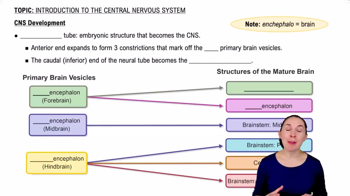
The primary brain vesicles are the prosencephalon (forebrain), mesencephalon (midbrain), and rhombencephalon (hindbrain).
The prosencephalon divides into the telencephalon and diencephalon.
The telencephalon forms the cerebral hemispheres, and the diencephalon forms the thalamus, hypothalamus, epithalamus, and retina.
Major flexures include the cephalic flexure, pontine flexure, and cervical flexure, which shape the brain's curvature.
Cerebral hemispheres grow posterolaterally to enclose the diencephalon and rostral brain stem.
The neural tube is the embryonic structure that gives rise to the brain and spinal cord.
Defects include spina bifida occulta, meningocele, and myelomeningocele, caused by incomplete closure of the neural tube.
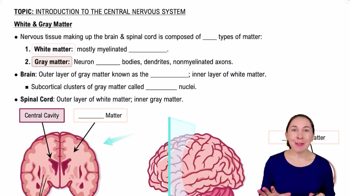
Gray matter contains neuron cell bodies and short nonmyelinated neurons; white matter contains mostly myelinated axons.
The brain has four ventricles (two lateral, third, and fourth) that contain cerebrospinal fluid and are connected by the cerebral aqueduct and central canal.
The choroid plexus is a layer of ependymal cells that produces cerebrospinal fluid from blood.
The meninges are the dura mater (outer tough layer), arachnoid mater (middle web-like layer), and pia mater (delicate inner layer).
The blood-brain barrier consists of tight junctions between capillary endothelial cells, supported by astrocytes, restricting passage of harmful substances while allowing nutrients.
Lipid-soluble substances like fats, fatty acids, gases, alcohol, nicotine, anesthetics, glucose, some amino acids, and specific ions can cross.
The metencephalon forms the pons and cerebellum; the myelencephalon forms the medulla oblongata.
The cerebral hemispheres control sensory and motor functions of the contralateral body side and are involved in higher mental functions.
Cerebral lateralization refers to the unequal sharing of functions between hemispheres, leading to cerebral dominance.
Association fibers connect areas within the same hemisphere, commissural fibers connect hemispheres, and projection fibers connect cortex to other brain regions.
The corpus callosum is the largest commissural fiber bundle connecting the two cerebral hemispheres.
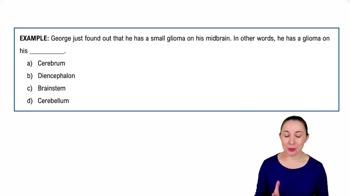
The diencephalon includes the thalamus, hypothalamus, epithalamus (including pineal gland), and subthalamic nuclei.
The thalamus acts as a relay station for sensory information (except olfaction) to the cerebral cortex.
The hypothalamus regulates visceral functions and maintains homeostasis.