Skip to main content
Anatomy & Physiology
My Course
Learn
Exam Prep
AI Tutor
Study Guides
Textbook Solutions
Flashcards
Explore
Try the app
My Course
Learn
Exam Prep
AI Tutor
Study Guides
Textbook Solutions
Flashcards
Explore
Try the app
Back
Endocrine System - Anatomy & Physiology
You can tap to flip the card.
What is the primary role of the endocrine system in the body?
You can tap to flip the card.
👆
What is the primary role of the endocrine system in the body?
The endocrine system contributes to
homeostasis
by releasing hormones that regulate physiological processes.
Track progress
Control buttons has been changed to "navigation" mode.
1/16
Recommended videos
7:06
Components of the Endocrine System
15236
views
458
rank
6:20
Hormones
11615
views
284
rank
3:33
Introduction to the Endocrine System Example 1
16400
views
490
rank
1
comments
Terms in this set (16)
Hide definitions
What is the primary role of the endocrine system in the body?
The endocrine system contributes to
homeostasis
by releasing hormones that regulate physiological processes.
What is the difference between paracrine and autocrine signaling?
Paracrine
signals affect nearby cells, while
autocrine
signals affect the same cell that released the hormone.
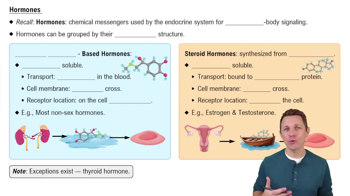
What are the two main chemical compositions of hormones?
Hormones are either
amino acid-based
(peptides or amines) or
steroid-based
(lipid-derived).
How do hormones act via second messenger systems?
A hormone binds to a receptor on the cell surface, triggering a
second messenger
inside the cell to initiate a response.
How do steroid hormones act differently from amino acid-based hormones?
Steroid hormones
directly enter the cell nucleus
and alter gene expression, unlike amino acid hormones that use second messengers.
What are the three types of hormone interactions for regulation?
Hormone release is regulated by
humoral
(blood chemistry),
neural
(nerve signals), and
hormonal
(other hormones) stimuli.
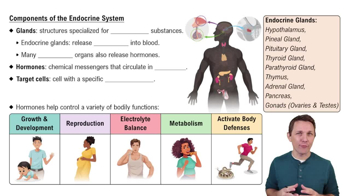
Where is the pituitary gland located and what is its general function?
The pituitary gland is located at the brain base and controls other endocrine glands by releasing multiple
tropic hormones
.
What hormone does the thyroid gland produce and what is its effect?
The thyroid gland produces
thyroxine (T4)
and
triiodothyronine (T3)
, which regulate metabolism and growth.
What is the role of the parathyroid glands?
Parathyroid glands secrete
parathyroid hormone (PTH)
to increase blood calcium levels.
What hormones are produced by the adrenal glands?
The adrenal glands produce
cortisol
,
aldosterone
, and
adrenaline (epinephrine)
for stress response and electrolyte balance.
What hormone does the pineal gland secrete and what is its function?
The pineal gland secretes
melatonin
, which regulates circadian rhythms and sleep cycles.
How is the reproductive system hormonally regulated?
The reproductive system is regulated by hormones like
gonadotropins
from the pituitary and sex hormones such as
estrogen
and
testosterone
.
What role do pancreatic endocrine cells play in blood glucose regulation?
Pancreatic cells release
insulin
to lower blood glucose and
glucagon
to raise blood glucose.
Which hormones are released by the heart with endocrine functions?
The heart releases
atrial natriuretic peptide (ANP)
to reduce blood volume and pressure.
What hormones do the kidneys release with endocrine functions?
The kidneys release
erythropoietin (EPO)
to stimulate red blood cell production.
What is the general function of hormones found throughout the body?
Hormones regulate
growth
,
metabolism
,
reproduction
, and
homeostasis
by acting on target cells.
 BackBack
 7:06