Skip to main content
Anatomy & Physiology
My Course
Learn
Exam Prep
AI Tutor
Study Guides
Textbook Solutions
Flashcards
Explore
Try the app
My Course
Learn
Exam Prep
AI Tutor
Study Guides
Textbook Solutions
Flashcards
Explore
Try the app
Back
Endocrine System - Anatomy & Physiology
You can tap to flip the card.
What are the two main types of glands in the endocrine system?
You can tap to flip the card.
👆
What are the two main types of glands in the endocrine system?
Exocrine glands
(ducted) and
endocrine glands
(ductless, secrete hormones into interstitial fluid and blood).
Track progress
Control buttons has been changed to "navigation" mode.
1/22
Recommended videos
7:06
Components of the Endocrine System
14978
views
457
rank
6:20
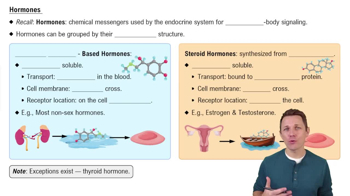
Hormones
11425
views
283
rank
3:33
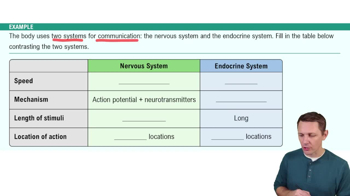
Introduction to the Endocrine System Example 1
16185
views
488
rank
1
comments
Terms in this set (22)
Hide definitions
What are the two main types of glands in the endocrine system?
Exocrine glands
(ducted) and
endocrine glands
(ductless, secrete hormones into interstitial fluid and blood).
How do hormones affect target cells?
Hormones bind to specific glycoprotein receptors on target cells, affecting only those cells with the correct receptors.
What is down-regulation in hormone activity?
A decrease in the number of hormone receptors to reduce sensitivity when hormone levels are high.
What is up-regulation in hormone activity?
An increase in the number of hormone receptors to increase sensitivity when hormone levels are low.
What are the two categories of hormones based on their solubility?
Lipid-soluble hormones
(steroids, thyroid hormones, nitric oxide) and
water-soluble hormones
(amines, peptides, proteins).
How do lipid-soluble hormones act on target cells?
They diffuse through the plasma membrane and bind to intracellular receptors, affecting gene transcription.
How do water-soluble hormones act on target cells?
They bind to receptors on the plasma membrane, activating second messenger systems like cAMP.
What is the role of the hypothalamus in the endocrine system?
It links the nervous and endocrine systems and controls the pituitary gland via releasing and inhibiting hormones.
What are the two lobes of the pituitary gland?
The
anterior pituitary
(adenohypophysis) and the
posterior pituitary
(neurohypophysis).
Name three hormones secreted by the anterior pituitary.
Human growth hormone (hGH), thyroid-stimulating hormone (TSH), and adrenocorticotropic hormone (ACTH).
What hormones does the posterior pituitary release?
Oxytocin (OT) and antidiuretic hormone (ADH), both produced by the hypothalamus.
What is the function of oxytocin?
Stimulates uterine contractions during labor and milk ejection from mammary glands.
What is the function of antidiuretic hormone (ADH)?
Decreases urine production by promoting water reabsorption in kidneys and increases blood pressure by constricting arterioles.
What hormones are produced by the thyroid gland?
Thyroxine (T4), triiodothyronine (T3), which increase metabolic rate, and calcitonin, which lowers blood calcium.
What is the role of parathyroid hormone (PTH)?
Increases blood calcium by stimulating osteoclast activity and decreasing phosphate levels.
What are the three zones of the adrenal cortex and their functions?
Zona glomerulosa (mineralocorticoids), zona fasciculata (glucocorticoids), zona reticularis (androgens).
What hormones are secreted by the adrenal medulla?
Epinephrine and norepinephrine, which intensify sympathetic 'fight or flight' responses.
What are the main endocrine cells in the pancreas and their secretions?
Alpha cells secrete glucagon, beta cells secrete insulin, delta cells secrete somatostatin, and F cells secrete pancreatic polypeptide.
What hormones do the ovaries produce?
Estrogens, progesterone, inhibin, and relaxin, regulating the menstrual cycle, pregnancy, and secondary sex characteristics.
What hormone do the testes produce?
Testosterone, which regulates sperm production and maintains male secondary sex characteristics.
What is the function of the pineal gland?
Secretes melatonin, which helps regulate the biological clock and promotes sleepiness.
What hormones are produced by the thymus?
Thymosin, thymic factor, and thymopoietin, all involved in T cell maturation.
 BackBack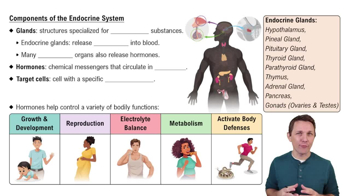
 7:06
7:06