Skip to main content
Anatomy & Physiology
My Course
Learn
Exam Prep
AI Tutor
Study Guides
Textbook Solutions
Flashcards
Explore
Try the app
My Course
Learn
Exam Prep
AI Tutor
Study Guides
Textbook Solutions
Flashcards
Explore
Try the app
Back
Endocrine System - Anatomy & Physiology
You can tap to flip the card.
Difference between nervous and endocrine systems
You can tap to flip the card.
👆
Difference between nervous and endocrine systems
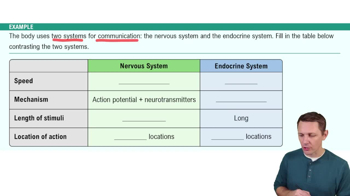
Nervous system
uses electrical impulses for fast, short-term responses;
endocrine system
uses hormones for slower, long-lasting effects.
Track progress
Control buttons has been changed to "navigation" mode.
1/29
Recommended videos
Guided course
7:06
Components of the Endocrine System
12530
views
384
rank
Guided course
6:20
Hormones
9612
views
237
rank
Guided course
3:33
Introduction to the Endocrine System Example 1
13734
views
387
rank
1
comments
Terms in this set (29)
Hide definitions
Difference between nervous and endocrine systems
Nervous system
uses electrical impulses for fast, short-term responses;
endocrine system
uses hormones for slower, long-lasting effects.
Autocrine, paracrine, and endocrine factors
Autocrine
: act on the same cell;
paracrine
: act on nearby cells;
endocrine
: hormones travel through blood to distant targets.
Chemical classes of hormones
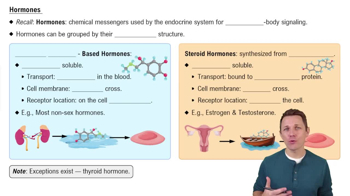
Hormones are classified as
amino acid derivatives
,
peptides/proteins
, and
steroids
.
Primary endocrine organs
Include the
pituitary gland
,
thyroid gland
,
parathyroid glands
,
adrenal glands
,
pineal gland
,
pancreas
,
ovaries
, and
testes
.
Mechanisms of hormone action
Hormones act via
cAMP
,
Ca2+
second messengers,
steroid hormone
receptors,
thyroxine
mechanisms, and
tyrosine kinase receptors
.
Factor affecting cell response to hormone
The number and sensitivity of
hormone receptors
on the target cell determine its response.
Downregulation vs. upregulation of hormone receptors
Downregulation
: decrease in receptor number due to high hormone levels;
upregulation
: increase in receptors due to low hormone levels.
Antagonistic, permissive, and synergistic hormone effects
Antagonistic
: hormones oppose each other;
permissive
: one hormone enhances another's effect;
synergistic
: hormones work together for greater effect.
Negative feedback in hormone regulation
Hormone levels are regulated by
negative feedback loops
that reduce hormone secretion when levels are sufficient.
Three endocrine gland stimuli
Stimuli include
humoral
(blood levels),
neural
(nerve signals), and
hormonal
(hormones stimulating other glands).
Command center of the endocrine system
The
hypothalamus
controls the endocrine system by regulating the
pituitary gland
.
Hormones secreted by hypothalamus and pituitary
Hypothalamus secretes releasing/inhibiting hormones; anterior pituitary releases hormones like
GH
,
TSH
,
ACTH
; posterior pituitary releases
ADH
and
oxytocin
.
Hypophyseal portal system
A network of blood vessels connecting the hypothalamus to the anterior pituitary for hormone transport.
Thyroid hormone synthesis and types
Thyroid hormones are made in the
thyroid gland
;
T4
(thyroxine) and
T3
differ in iodine content and activity.
Functions of thyroxine (TH)
TH regulates
metabolism
,
growth
, and
development
.
How calcitonin lowers blood calcium
Calcitonin decreases blood calcium by inhibiting
osteoclast
activity and promoting calcium deposition in bones.
Location of parathyroid glands
Parathyroid glands are located on the
posterior surface
of the thyroid gland.
Regulation of blood calcium by PTH and calcitonin
PTH
increases blood calcium by stimulating bone resorption;
calcitonin
lowers it by inhibiting bone resorption.
Three phases of General Adaptation Syndrome
Phases are
alarm
,
resistance
, and
exhaustion
in response to stress.
Adrenal cortex layers and hormones
Layers:
zona glomerulosa
(mineralocorticoids),
zona fasciculata
(glucocorticoids),
zona reticularis
(androgens).
Adrenal medulla secretion and function
Secretes
epinephrine
and
norepinephrine
for fight-or-flight response.
Function of pineal gland and melatonin
Pineal gland secretes
melatonin
, which regulates
circadian rhythms
and sleep.
Hormones from ovaries, testes, and placenta
Ovaries produce
estrogen
and
progesterone
; testes produce
testosterone
; placenta produces hormones supporting pregnancy.
Pancreatic hormone secretion
Alpha cells secrete
glucagon
, beta cells secrete
insulin
, delta cells secrete
somatostatin
, PP cells secrete
pancreatic polypeptide
.
Glucagon and insulin in blood glucose homeostasis
Glucagon
raises blood glucose;
insulin
lowers blood glucose.
Definition and types of diabetes
Diabetes is a disorder of blood glucose regulation;
Type I
is insulin deficiency;
Type II
is insulin resistance.
Organs with secondary endocrine functions
Include heart, kidneys, digestive tract, and adipose tissue, secreting hormones like
ANP
,
erythropoietin
, and others.
Embryonic germ layers of endocrine glands
Endocrine glands arise from
ectoderm
,
mesoderm
, or
endoderm
depending on the gland.
Common endocrine disorders and causes
Disorders include
dwarfism
,
gigantism
,
acromegaly
,
goiter
,
cretinism
,
Grave's disease
,
Cushing's syndrome
, and
Addison's disease
.
 BackBack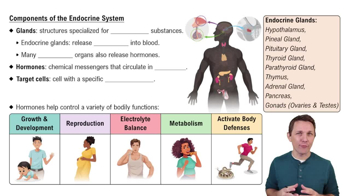
 7:06
7:06