Back

Endocrine System - Anatomy & Physiology

Control buttons has been changed to "navigation" mode.
1/27
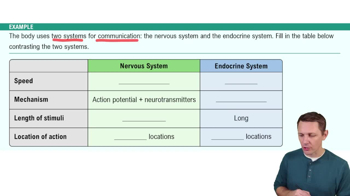
  • What is the main difference between endocrine and nervous system signaling?

    The endocrine system releases hormones into the blood for distant target cells, causing slower but longer-lasting effects, while the nervous system uses neurotransmitters for rapid, short-term signaling to nearby target cells.
  • Define endocrine, paracrine, and autocrine signaling.

    • Endocrine: Hormones secreted into blood to distant cells.
    • Paracrine: Chemicals act on nearby cells via extracellular fluid.
    • Autocrine: Chemicals act on the same cell that secreted them.
  • What distinguishes endocrine glands from exocrine glands?

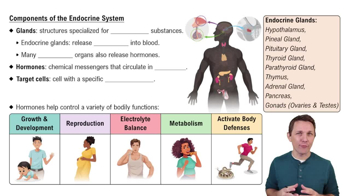
    Endocrine glands are ductless and secrete hormones directly into the blood, while exocrine glands secrete substances into ducts leading to body surfaces or cavities.
  • Name major endocrine organs in the human body.

    Hypothalamus, pituitary gland, thyroid gland, parathyroid glands, adrenal cortex, endocrine pancreas, thymus, ovaries (female), testes (male).
  • What are the three major chemical classes of hormones?

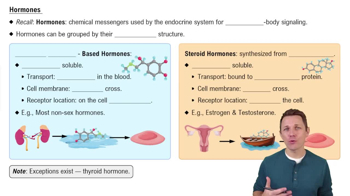
    • Peptides/proteins (hydrophilic)
    • Amines (usually hydrophilic)
    • Steroids (from cholesterol, hydrophobic)
  • How do hydrophilic hormones act on target cells?

    They bind to plasma membrane receptors, activating G-proteins and adenylate cyclase to produce second messengers like cAMP, which activate protein kinases to alter cell function.
  • How do hydrophobic hormones act on target cells?

    They diffuse through the plasma membrane, bind intracellular receptors, and the hormone-receptor complex interacts with DNA to regulate gene transcription.
  • What is receptor upregulation and downregulation?

    • Upregulation: Low hormone levels cause target cells to increase receptor numbers, increasing sensitivity.
    • Downregulation: High hormone levels cause target cells to decrease receptor numbers, reducing sensitivity.
  • Describe the hypothalamus-pituitary relationship.

    The hypothalamus connects to the pituitary gland via the infundibulum; it produces neurohormones stored in the posterior pituitary and releases tropic hormones that regulate anterior pituitary hormone secretion.
  • What hormones are released by the posterior pituitary and their functions?

    • ADH: increases water reabsorption in kidneys, reducing urine output.
    • Oxytocin: stimulates milk ejection and uterine contractions during childbirth.
  • Explain the hormone release process of the anterior pituitary.

    Hypothalamus secretes releasing or inhibiting hormones into portal veins, which stimulate or inhibit anterior pituitary cells to release hormones that act on target tissues or other endocrine glands.
  • What is the role of tropic hormones?

    Tropic hormones from the anterior pituitary regulate the secretion of hormones from other endocrine glands, forming hormone release tiers.
  • Name the three tiers in hypothalamic-pituitary hormone axes.

    • First tier: Hypothalamic releasing hormones.
    • Second tier: Anterior pituitary hormones.
    • Third tier: Target gland hormones.
  • What cells produce thyroid hormones and calcitonin in the thyroid gland?

    Follicle cells produce thyroid hormones (T3 and T4), and parafollicular cells produce calcitonin.
  • What are the main effects of thyroid hormones?

    Increase basal metabolic rate, promote protein synthesis, stimulate growth and development, and increase sensitivity to sympathetic nervous system.
  • How does calcitonin regulate calcium levels?

    Calcitonin lowers blood calcium by inhibiting osteoclast activity and promoting calcium deposition in bones, released in response to hypercalcemia.
  • What is the function of parathyroid hormone (PTH)?

    PTH increases blood calcium by stimulating osteoclasts, increasing calcium absorption in intestines, and reducing calcium excretion by kidneys, released in response to hypocalcemia.
  • Describe the adrenal cortex zones and their hormone products.

    • Zona glomerulosa: mineralocorticoids (e.g., aldosterone)
    • Zona fasciculata: glucocorticoids (e.g., cortisol)
    • Zona reticularis: androgens
  • What are the main functions of aldosterone?

    Regulates sodium and potassium levels, maintains extracellular fluid volume, blood pressure, and acid-base balance.
  • What are the effects of cortisol?

    Promotes gluconeogenesis, suppresses immune response, reduces inflammation, and helps the body respond to stress.
  • What hormones are secreted by the adrenal medulla?

    Catecholamines: epinephrine and norepinephrine, which mediate sympathetic nervous system responses.
  • What are the endocrine functions of the pancreas?

    Pancreatic islets secrete glucagon (alpha cells) to increase blood glucose and insulin (beta cells) to decrease blood glucose.
  • How do insulin and glucagon maintain blood glucose homeostasis?

    Insulin lowers blood glucose by promoting uptake and storage; glucagon raises blood glucose by stimulating glycogen breakdown and gluconeogenesis.
  • What causes type 1 and type 2 diabetes mellitus?

    Type 1: autoimmune destruction of beta cells causing insulin deficiency. Type 2: insulin resistance often linked to obesity and heredity.
  • Name some hormones produced by other endocrine tissues besides glands.

    Leptin from adipose tissue regulates appetite; atrial natriuretic peptide (ANP) from heart causes vasodilation; erythropoietin (EPO) from kidneys stimulates red blood cell production.
  • What is the role of the pineal gland hormone melatonin?

    Regulates sleep-wake cycles and circadian rhythms, influenced by light and dark.
  • How do hormones and the nervous system interact during stress?

    The nervous system triggers adrenal medulla catecholamine release and stimulates hypothalamic-pituitary-adrenal axis to release cortisol, coordinating metabolic and cardiovascular responses.