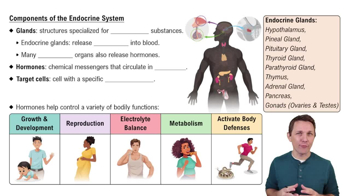
The endocrine system regulates body functions through hormones that control growth, metabolism, reproduction, and homeostasis.
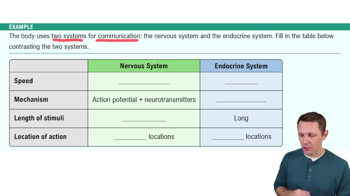
Types of signaling in the endocrine system
Autocrine: affects the same cell that secretes the signal. Paracrine: affects nearby cells. Endocrine: affects distant cells via the bloodstream.
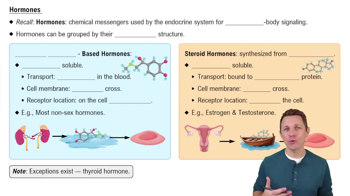
Difference between steroid and amino acid/peptide hormones
Steroid hormones are lipid-soluble and pass through cell membranes to bind intracellular receptors. Amino acid/peptide hormones are water-soluble and bind to cell surface receptors.
How steroid hormones travel and signal target cells
Steroid hormones travel bound to carrier proteins in the blood and diffuse through the target cell membrane to bind intracellular receptors, affecting gene transcription.
How amino acid/peptide hormones travel and signal target cells
These hormones travel freely in the blood and bind to receptors on the target cell surface, triggering second messenger pathways.
Hormonal regulation of secretion
Hormone secretion can be regulated by hormonal signals, where one hormone controls the release of another in a tiered feedback system.
Negative feedback loop in hormone regulation
A process where increased hormone levels inhibit further hormone release to maintain homeostasis.
Positive feedback loop in hormone regulation
A process where hormone release is amplified by its own effects, increasing hormone levels.
Up-regulation of hormone receptors
An increase in receptor number on target cells, making them more sensitive to a hormone.
Down-regulation of hormone receptors
A decrease in receptor number on target cells, reducing sensitivity to a hormone.
Hormones released from the posterior pituitary
Antidiuretic hormone (ADH) and oxytocin are released from the posterior pituitary.
Hormones under neural control
Hormones released in response to nervous system signals, e.g., ADH and oxytocin from the posterior pituitary.
Hormones under humoral control
Hormones released in response to changes in blood chemistry, e.g., parathyroid hormone responding to calcium levels.
Hormones under hormonal control
Hormones released in response to other hormones, e.g., thyroid stimulating hormone (TSH) stimulating thyroid hormone release.
 Back
 7:06