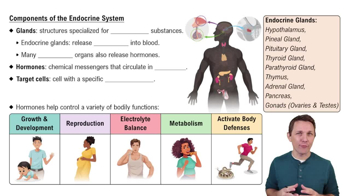
Releases chemical messengers called hormones into the bloodstream to regulate metabolic activities and maintain homeostasis.
Difference between endocrine and nervous systems
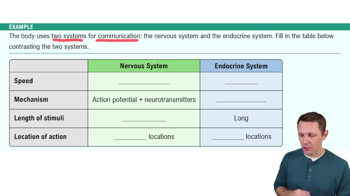
The nervous system uses fast electrochemical impulses for rapid responses; the endocrine system uses hormones for slower, prolonged metabolic regulation.
Difference between endocrine and exocrine glands
Endocrine glands are ductless and release hormones into blood; exocrine glands have ducts and secrete non-hormonal products to surfaces.
Two chemical classes of hormones
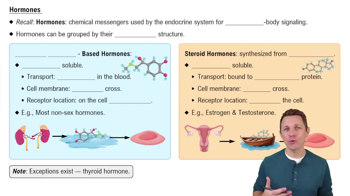
Amino acid-based hormones (most hormones, act via second messengers) and steroid hormones (from cholesterol, act via direct gene activation).
Mechanism of action for amino acid-based hormones
Bind to cell membrane receptors and activate intracellular second messengers like cyclic AMP to alter cell function.
Mechanism of action for steroid hormones
Diffuse into cells, bind nuclear receptors, and activate gene transcription to produce specific proteins.
Factors affecting target cell activation by hormones
Blood hormone levels, number of receptors on target cells, and affinity between hormone and receptor.
Types of cellular changes induced by hormones
Changes in membrane permeability, protein synthesis, enzyme activity, secretory activity, and stimulation of mitosis.
Five broad effects of hormones on the body
Regulate internal environment, respond to stress, integrate growth and development, support reproduction, and regulate metabolism and energy balance.
Three types of stimuli that trigger hormone secretion
Hormonal (hormones stimulate other glands), humoral (changes in blood ions/nutrients), and neural (nerve fibers stimulate hormone release).
Role of the hypothalamus in endocrine control
Controls pituitary gland by producing releasing and inhibiting hormones for anterior pituitary and directly releasing posterior pituitary hormones via neurons.
Hormones released by the posterior pituitary
Oxytocin (uterine contractions) and antidiuretic hormone (ADH) (water reabsorption in kidneys).
Six hormones secreted by the anterior pituitary
TSH, ACTH, FSH, LH (regulate other glands), plus growth hormone (GH) and prolactin (PRL) affecting non-endocrine targets.
Function of thyroid hormone
Major metabolic hormone that increases basal metabolic rate, heat production, and tissue growth; includes T4 and active T3.
Function of calcitonin
Lowers blood calcium by stimulating calcium uptake into bone; produced by thyroid parafollicular cells.
Role of parathyroid hormone (PTH)
Increases blood calcium by stimulating bone resorption, kidney reabsorption, and intestinal absorption of calcium.
Hormones produced by the adrenal cortex layers
Zona glomerulosa: mineralocorticoids (e.g., aldosterone); zona fasciculata: glucocorticoids (e.g., cortisol); zona reticularis: gonadocorticoids (androgens).
Function of aldosterone
Regulates sodium and potassium balance by promoting sodium reabsorption and potassium excretion in kidneys, increasing blood volume.
Role of glucocorticoids
Help maintain blood sugar, resist stress, and regulate metabolism; cortisol is a key glucocorticoid.
Hormones secreted by the adrenal medulla
Catecholamines epinephrine and norepinephrine, which mediate short-term stress responses like increased heart rate and blood sugar.
Function of insulin
Lowers blood glucose by promoting cellular glucose uptake, glycogen formation, and glucose breakdown for ATP.
Function of glucagon
Raises blood glucose by stimulating glycogen breakdown and gluconeogenesis in the liver.
Hormones produced by the gonads
Ovaries produce estrogen and progesterone; testes produce testosterone; all are steroid hormones regulating reproduction and secondary sex characteristics.
Role of the thymus gland
Produces thymosin, which is important for T lymphocyte development and immune response.
Cause and effect of gigantism
Hypersecretion of growth hormone in children causes excessive height with normal body proportions.
Cause and effect of acromegaly
Hypersecretion of growth hormone after epiphyseal plate closure causes enlargement of hands, feet, and face.
Cause and effect of diabetes insipidus
ADH deficiency leading to excessive urine output and intense thirst.
 Back
 7:06