Back

Endocrine System - Anatomy & Physiology Chapter 17

Control buttons has been changed to "navigation" mode.
1/24
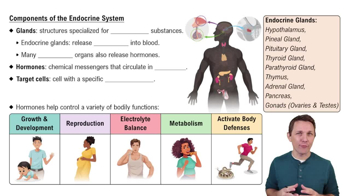
  • What is an endocrine gland?

    A ductless gland that releases hormones into interstitial fluid and then the bloodstream.
  • Define hormone.

    A chemical messenger that circulates in blood and affects cells with the correct receptor.
  • What is a target cell?

    A cell influenced by a hormone because it expresses the appropriate receptor.
  • What is a tropic hormone?

    A hormone that stimulates another endocrine gland to secrete hormones.
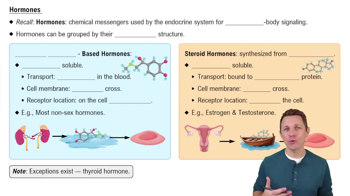
  • Compare amino acid–based and steroid hormones.

    Amino acid–based hormones are made from amino acids and have abundant rough ER; steroid hormones are derived from cholesterol and have extensive smooth ER.
  • Name the three types of stimuli that trigger hormone secretion.

    Humoral (blood ion/nutrient changes), Neural (nerve input), and Hormonal (hormones from other glands).
  • How does negative feedback regulate hormone secretion?

    When hormone levels or effects fall, secretion increases; when levels rise sufficiently, secretion decreases or stops.
  • What hormones does the anterior pituitary secrete?

    TSH, ACTH, FSH, LH (tropic hormones); GH, PRL, MSH (direct-acting hormones).
  • What is the main function of ADH?

    Increases water reabsorption in kidneys and constricts arterioles to raise blood pressure.
  • Where are ADH and oxytocin synthesized and stored?

    Synthesized in the hypothalamus; stored and released by the posterior pituitary.
  • What hormone do thyroid follicular cells produce?

    Thyroid hormone (TH), which supports metabolic activity and development.
  • What hormone do thyroid parafollicular cells produce?

    Calcitonin, which helps regulate blood calcium levels.
  • How does parathyroid hormone (PTH) raise blood calcium?

    Stimulates osteoclasts to release Ca²⁺ from bone, decreases Ca²⁺ excretion by kidneys, and activates vitamin D to increase intestinal Ca²⁺ uptake.
  • Name the three adrenal cortex zones and their hormones.

    Zona glomerulosa: aldosterone; zona fasciculata: cortisol; zona reticularis: DHEA/adrenal androgens.
  • What hormones are secreted by the adrenal medulla?

    Epinephrine and norepinephrine, which enhance the short-term fight-or-flight response.
  • What is the difference between short-term and prolonged stress pathways?

    Short-term: sympathetic nerves stimulate adrenal medulla (epinephrine/norepinephrine). Prolonged: hypothalamus → ACTH → adrenal cortex (mineralocorticoids/glucocorticoids).
  • Which pancreatic cells secrete insulin and glucagon?

    Beta cells secrete insulin; alpha cells secrete glucagon.
  • What is the effect of insulin on blood glucose?

    Lowers blood glucose by promoting cellular uptake and glycogen storage.
  • What is the effect of glucagon on blood glucose?

    Raises blood glucose by signaling the liver to release glucose from glycogen.
  • What hormone does the pineal gland secrete and what is its function?

    Melatonin, which regulates circadian rhythms.
  • What causes gigantism and acromegaly?

    Excess growth hormone (GH); gigantism occurs in children, acromegaly in adults.
  • What is diabetes insipidus?

    A condition caused by too little ADH, leading to reduced water conservation by the kidneys.
  • How do Graves’ disease and Hashimoto’s disease differ?

    Graves’ disease causes excess thyroid hormone (hyperthyroidism); Hashimoto’s causes thyroid destruction and low hormone (hypothyroidism).
  • What is the difference between diabetes mellitus and diabetes insipidus?

    Diabetes mellitus involves insulin and glucose regulation; diabetes insipidus involves ADH and water balance.