 Back
Endocrine System - Anatomy & Physiology Flashcards
 7:06

Terms in this set (21)
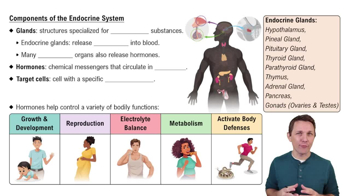
Endocrine cells secrete hormones into the bloodstream, which act as chemical messengers to regulate growth, metabolism, reproduction, blood glucose, and homeostasis.
Down-regulation is when target cells decrease hormone receptors or responsiveness, reducing hormone effects.
Cells become less responsive to insulin, causing high blood glucose. The pancreas compensates by releasing more insulin, but eventually cannot maintain control, contributing to Type 2 diabetes.
The hypothalamus connects the nervous and endocrine systems and controls the pituitary gland through releasing and inhibiting hormones.
Growth hormone (GH), Thyroid-stimulating hormone (TSH), Adrenocorticotropic hormone (ACTH), Follicle-stimulating hormone (FSH), Luteinizing hormone (LH), Prolactin (PRL).
GH promotes body growth and affects metabolism.
TSH stimulates the thyroid gland to produce thyroid hormones.
ACTH stimulates the adrenal cortex to release corticosteroids.
FSH supports egg development in ovaries and sperm production in testes.
LH triggers ovulation and stimulates sex hormone production.
Prolactin (PRL) stimulates milk production in mammary glands.
Prolactin produces milk, while oxytocin causes milk ejection (let-down reflex).
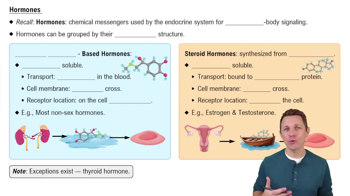
Hormones made of amino acid chains, water-soluble, bind to cell membrane receptors, and activate second messenger systems. Examples: insulin, GH, prolactin, ADH.
ADH (antidiuretic hormone) and oxytocin are stored and released by the posterior pituitary but produced in the hypothalamus.
Fatigue, weight gain, cold intolerance, constipation, dry skin, hair thinning, slow heart rate, difficulty concentrating, depression, and puffy face.
Follicular cells of the thyroid secrete thyroxine (T4), and parafollicular (C) cells secrete calcitonin.
Thyroxine increases metabolic activity and supports growth and development.
Calcitonin lowers blood calcium levels mainly by inhibiting osteoclast activity.
FLAT PiG: FSH, LH, ACTH, TSH, Prolactin, Growth hormone.
Insulin signals cells to take glucose from the blood, lowering blood glucose levels.
Cells become less responsive to insulin signaling, reducing glucose uptake despite insulin presence.