Back

Endocrine System - Anatomy & Physiology II

Control buttons has been changed to "navigation" mode.
1/21
  • Main difference between nervous and endocrine systems

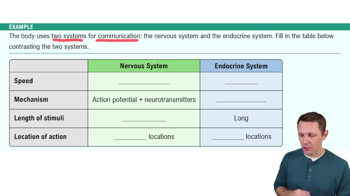
    The nervous system uses electrical signals for rapid, short-term control, while the endocrine system uses hormones for slower, long-lasting regulation of cell activity.
  • Classes of hormones based on solubility

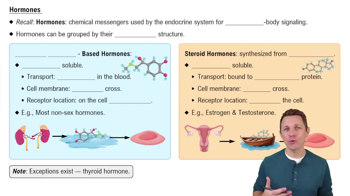
    Hormones are classified as either lipid-soluble (steroid and thyroid hormones) or water-soluble (peptides, proteins, and amines).
  • Direct gene activation mechanism

    Lipid-soluble hormones cross the cell membrane, bind to intracellular receptors, and directly activate genes to produce proteins.
  • Second messenger system

    Water-soluble hormones bind to surface receptors, triggering a cascade that produces second messengers like cAMP to alter cell activity.
  • Three stimulation methods for hormone release

    Hormones are released by neural stimulation, hormonal stimulation (hormones stimulating other hormones), and humoral stimulation (changes in blood chemistry).
  • Hormones produced by the hypothalamus

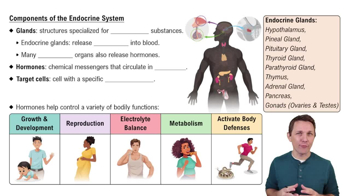
    The hypothalamus produces oxytocin, antidiuretic hormone (ADH), releasing hormones, and inhibiting hormones.
  • Anterior pituitary hormones

    The anterior pituitary secretes TSH, ACTH, FSH, LH, GH, PRL, and MSH.
  • Posterior pituitary hormones

    The posterior pituitary releases oxytocin and antidiuretic hormone (ADH).
  • Thyroid gland components

    The thyroid contains follicles filled with colloid, follicle cells that produce thyroid hormones, and clear cells that produce calcitonin.
  • Thyroid hormones and their functions

    Thyroxine (T4) and triiodothyronine (T3) regulate metabolism; calcitonin lowers blood calcium levels.
  • Parathyroid hormone (PTH)

    PTH is produced by parathyroid cells and increases blood calcium by stimulating bone resorption and calcium absorption.
  • Adrenal gland structure

    The adrenal gland has a cortex (produces steroid hormones) and a medulla (produces catecholamines like adrenaline).
  • Hormones of the adrenal cortex zones

    The zona glomerulosa produces mineralocorticoids, zona fasciculata produces glucocorticoids, and zona reticularis produces androgens.
  • Pancreatic islets of Langerhans cell types

    Alpha cells produce glucagon; beta cells produce insulin.
  • Functions of glucagon and insulin

    Glucagon raises blood glucose by stimulating glycogen breakdown; insulin lowers blood glucose by promoting uptake and storage.
  • Types of diabetes mellitus

    Type I diabetes is insulin deficiency due to autoimmune destruction of beta cells; Type II is insulin resistance.
  • Hormone produced by the pineal gland

    The pineal gland produces melatonin, which regulates circadian rhythms.
  • Hormones secreted by the thymus

    The thymus secretes thymosins, which are involved in T-cell development and immune function.
  • Gonadal hormones

    Testes produce testosterone; ovaries produce estrogen and progesterone.
  • Four types of hormone interactions

    Hormones can interact via permissive, synergistic, antagonistic, or additive effects.
  • General Adaptation Syndrome (GAS)

    GAS is the body's three-stage response to stress: alarm, resistance, and exhaustion.