 Back
Endocrine System and Control of Body Movement - Anatomy & Physiology
 7:06

Terms in this set (25)
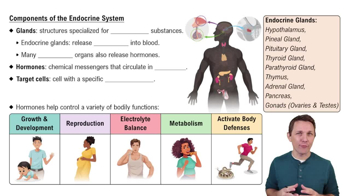
Hormones are chemical messengers secreted into the blood by glands or isolated cells, transported to distant target cells that have specific receptors, and effective at very low concentrations (10-9 to 10-12 M).
Hormones bind to receptors on target cells, triggering signal transduction pathways; cells without receptors do not respond.
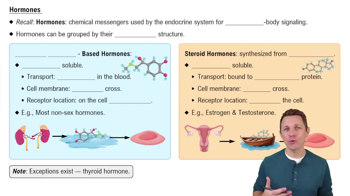
Hormones are classified as peptide/protein hormones, steroid hormones (from cholesterol), and amine hormones (from tyrosine or tryptophan).
Peptide hormones are synthesized as inactive preprohormones on ribosomes, processed to prohormones in the ER, further processed in the Golgi, and stored in secretory vesicles before release by exocytosis.
Peptide hormones are water-soluble and dissolved in plasma; they have a short half-life of a few minutes due to rapid degradation.
Peptide hormones bind to membrane receptors, activating signal transduction systems that rapidly modify existing proteins or ion channels.
Steroid hormones are synthesized on demand by the smooth ER, are lipophilic, and diffuse out of cells after synthesis.
Steroid hormones are hydrophobic, transported bound to carrier proteins, and have a longer half-life of 60-90 minutes.
Steroid hormones bind to intracellular receptors in the cytoplasm or nucleus, forming complexes that regulate gene expression and protein synthesis.
Amine hormones are derived from the amino acids tyrosine and tryptophan, including catecholamines and thyroid hormones.
Stimulus, sensor (receptor), input signal, integration center, output signal (hormone), target cells, response, and usually negative feedback.
Hormones produced in the pathway act as negative feedback signals to inhibit secretion at the hypothalamus or pituitary, maintaining homeostasis.
Synergism occurs when two hormones have the same effect using different mechanisms, producing a combined effect greater than the sum of individual effects.
Permissiveness means one hormone must be present for another hormone to exert its full effect, e.g., thyroid hormone with reproductive hormones.
Antagonistic hormones have opposing effects, where one hormone diminishes the effect of another, such as insulin vs. glucagon.
Hypersecretion is excess hormone secretion often due to tumors; hyposecretion is insufficient hormone secretion, possibly from damage along the control pathway.
Down-regulation is a decrease in receptor number in response to high hormone levels, reducing target cell responsiveness.
Stimulus, receptor, sensory neuron, integrating center (CNS), motor (efferent) neuron(s), effector, and response.
Golgi tendon organs, muscle spindles, and joint receptors provide sensory input about muscle tension, length, and joint position.
Involves a sensory neuron and motor neuron; muscle stretch causes contraction of the same muscle (agonist) and inhibition of antagonistic muscles (reciprocal inhibition).
It senses muscle tension at the tendon-muscle junction and helps regulate muscle contraction to prevent damage.
A polysynaptic reflex that withdraws a limb from painful stimuli, often accompanied by the crossed extensor reflex to maintain balance.
Voluntary movements require coordination between the cerebral cortex, cerebellum, and basal nuclei, involving decision-making, initiation, and execution phases.
The cerebellum fine-tunes movements by integrating sensory feedback and coordinating timing and precision.
Neural circuits in the spinal cord that produce rhythmic motor patterns like walking, maintained without continuous cortical input.