 Back
BackEndocrine System and Hormonal Regulation
 7:06
7:06
Terms in this set (28)
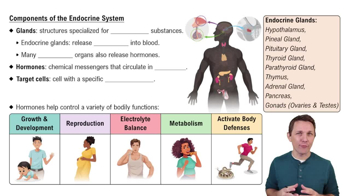
A gland that secretes hormones directly into the bloodstream to regulate body functions.
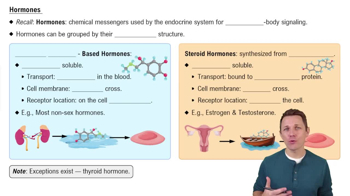
A chemical messenger secreted by endocrine glands that travels through the blood to target cells.
A cell that has specific receptors for a hormone and responds to its signal.
A protein on or inside a target cell that binds to a specific hormone to trigger a response.
A molecule inside the cell that transmits signals from a hormone-receptor complex to trigger cellular responses.
Cyclic adenosine monophosphate, a common second messenger that activates protein kinases inside cells.
An enzyme that phosphorylates proteins, altering their activity in response to hormonal signals.
The addition of a phosphate group to a protein, often regulating its function and activity.
A regulatory mechanism where the output of a process inhibits its own production to maintain homeostasis.
Hormone release triggered by changes in blood levels of ions or nutrients.
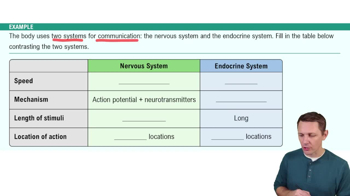
Hormone release triggered by nerve impulses.
Hormone release triggered by another hormone.
The master endocrine gland that controls other endocrine glands and regulates growth and metabolism.
A brain region that controls the pituitary gland and links the nervous system to the endocrine system.
An endocrine gland that produces hormones regulating metabolism, such as thyroxine (T₄) and triiodothyronine (T₃).
Small glands located behind the thyroid that regulate calcium levels by secreting parathyroid hormone (PTH).
A hormone from the thyroid that lowers blood calcium levels by inhibiting bone resorption.
A hormone that increases blood calcium levels by stimulating bone resorption and calcium absorption.
A thyroid hormone that regulates metabolism and is converted into the active form T₃ in tissues.
The active thyroid hormone that influences metabolic rate and protein synthesis.
A hormone that can cross cell membranes and bind to intracellular receptors, often affecting gene expression.
A hormone that cannot cross the cell membrane and binds to surface receptors, triggering second messenger pathways.
An increase in receptor number on target cells, making them more sensitive to a hormone.
A decrease in receptor number on target cells, reducing their sensitivity to a hormone.
When one hormone enhances the effect of another hormone on a target cell.
When two hormones produce a greater combined effect than the sum of their separate effects.
When one hormone opposes or inhibits the action of another hormone.
The maintenance of a stable internal environment despite external changes, often regulated by hormones.