The endocrine system influences metabolic activities via hormones transported in blood and works with the nervous system to coordinate body cell activities and maintain homeostasis.
Negative feedback in hormone regulation
Most hormones are regulated by negative feedback, where the response reduces or shuts off the original stimulus to maintain stable blood levels.
Hormonal regulation of blood glucose
When blood glucose rises, pancreatic beta cells secrete insulin to promote glucose uptake by cells, lowering blood glucose. When glucose falls, alpha cells secrete glucagon to raise glucose by stimulating glycogen breakdown.
Comparison of nervous and endocrine systems
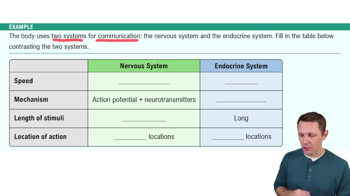
Nervous system responses are rapid and short-lived, acting via neurotransmitters at specific locations. Endocrine responses are slower and longer-lasting, acting via hormones that travel through blood to diffuse locations.
Exocrine vs endocrine glands
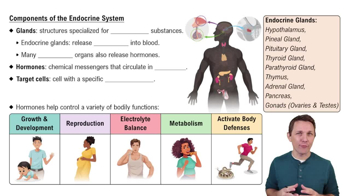
Exocrine glands secrete nonhormonal substances via ducts. Endocrine glands lack ducts and secrete hormones directly into the blood.
Types of chemical signaling
Endocrine signaling uses hormones traveling in blood for long-distance effects. Paracrine signaling affects nearby cells. Autocrine signaling affects the same cell that secreted the chemical.
Target cells and hormone specificity
Hormones affect only cells with specific receptors for that hormone, called target cells.
Hormone actions on target cells
Hormones can alter membrane permeability, stimulate protein synthesis, activate or deactivate enzymes, induce secretion, or stimulate mitosis in target cells.
Classes of hormones
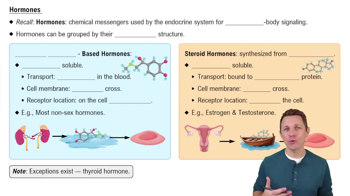
Two main classes: amino acid-based hormones (peptides, proteins) and steroid hormones (derived from cholesterol).
Water-soluble vs lipid-soluble hormones
Water-soluble hormones act on plasma membrane receptors via second messengers. Lipid-soluble hormones enter cells and act on intracellular receptors to directly activate genes.
Cyclic AMP (cAMP) second messenger system
Hormone binds receptor → activates G protein → activates adenylate cyclase → converts ATP to cAMP → cAMP activates protein kinases → phosphorylates proteins → cellular response.
PIP2-calcium second messenger system
Hormone activates G protein → activates phospholipase C → splits PIP2 into DAG and IP3 → IP3 releases intracellular Ca2+ → Ca2+ and DAG activate protein kinase → cellular response.
Direct gene activation by steroid hormones
Steroid hormones diffuse into cell → bind intracellular receptor → receptor-hormone complex enters nucleus → binds DNA → initiates mRNA transcription → protein synthesis.
Types of endocrine gland stimuli
Hormone release triggered by humoral stimuli (blood ion/nutrient levels), neural stimuli (nerve fibers), and hormonal stimuli (hormones stimulating other glands).
Target cell activation factors
Activation depends on blood hormone levels, receptor number (up/down regulation), and receptor-hormone binding affinity.
Half-life of hormones
Time for blood hormone level to decrease by half; water-soluble hormones have short half-lives, steroids longer due to protein binding.
Hypothalamic-pituitary relationship
Hypothalamus controls pituitary via releasing/inhibiting hormones; anterior pituitary secretes tropic hormones regulating other endocrine glands.
Posterior pituitary hormones
Oxytocin stimulates uterine contractions and milk ejection; ADH regulates water balance by promoting kidney water reabsorption.
Growth hormone (GH) functions
GH promotes growth by stimulating IGFs, increases blood glucose, mobilizes fats, and supports protein synthesis.
Thyroid hormone (TH) types and functions
TH includes T4 (thyroxine) and T3 (triiodothyronine); increases basal metabolic rate, regulates growth, and maintains blood pressure.
Parathyroid hormone (PTH) role
PTH increases blood Ca2+ by stimulating bone resorption, kidney reabsorption of Ca2+, and activating vitamin D to enhance intestinal Ca2+ absorption.
Adrenal cortex hormones
Mineralocorticoids regulate electrolytes (e.g., aldosterone controls Na+ and K+), glucocorticoids (e.g., cortisol) regulate metabolism and stress response, gonadocorticoids produce weak androgens.
Adrenal medulla hormones
Secretes catecholamines epinephrine and norepinephrine, which increase heart rate, blood glucose, and vasoconstriction during stress.
Pancreatic hormones
Alpha cells secrete glucagon to raise blood glucose; beta cells secrete insulin to lower blood glucose and promote glucose uptake.
Diabetes mellitus causes and symptoms
Caused by insulin hyposecretion (Type 1) or hypoactivity (Type 2); symptoms include polyuria, polydipsia, and polyphagia.
Gonadal hormone functions
Ovaries produce estrogens and progesterone for reproductive organ maturation and cyclic changes; testes produce testosterone for male characteristics and sperm production.
 Back
 7:06