Produces serotonin by day and converts it to melatonin at night to regulate circadian rhythm and may regulate timing of puberty.
Thymus gland role
Located in mediastinum, shrinks after puberty, secretes hormones that regulate T-cell development.
Parathyroid hormone (PTH) effect
Released in response to low blood Ca2+ levels and increases Ca2+ concentration in blood.
Pancreas endocrine vs exocrine function
2% of pancreas (islets) produce hormones; 98% produce digestive enzymes (exocrine).
Insulin secretion and function
Secreted by beta cells after meals with carbs/protein; stimulates glucose and amino acid uptake; antagonizes glucagon.
Glucagon secretion and function
Secreted by alpha cells during fasting or low-carb diets; stimulates glycogen breakdown and fat catabolism; antagonizes insulin.
Signs of diabetes mellitus
Polyuria, polydipsia, polyphagia, hyperglycemia, glycosuria, ketonuria, and osmotic diuresis.
Type I diabetes mellitus characteristics
Autoimmune destruction of beta cells, usually diagnosed around age 12, requires insulin injections.
Type II diabetes mellitus characteristics
Insulin resistance with failure of target cells to respond; risk factors include heredity, age 40+, and obesity.
Long-term diabetes complications
Vascular damage causing heart and kidney disease, retinal damage (blindness), poor wound healing, and limb amputations.
Hyperinsulinism causes and symptoms
Caused by excess insulin injection or islet tumor; causes hypoglycemia, weakness, hunger, anxiety, sweating, and increased heart rate.
Gestational diabetes
Occurs during pregnancy due to placental hormones deactivating insulin receptors; reverses after birth but increases type II diabetes risk.
Gonadal hormone functions
Ovaries secrete estrogens and progesterone for female development and pregnancy; testes produce androgens for male development and sperm production.
Atrial natriuretic peptide (ANP) role
Released with increased blood pressure; decreases blood volume and blood pressure.
Hormone chemical nature
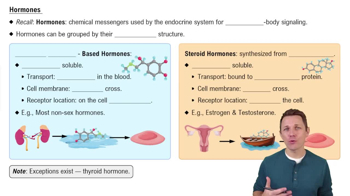
Most hormones are protein-based (water-soluble); steroid hormones are lipid-soluble.
Lipid-soluble hormone mode of action
Penetrate plasma membrane, enter nucleus, bind DNA, initiate mRNA transcription, and stimulate protein synthesis.
Water-soluble hormone mode of action
Bind to cell-surface receptors and activate second messenger systems inside the cell.
Hormone clearance mechanisms
Hormones are degraded by liver and kidney, excreted in bile or urine; half-life is time to clear 50% of hormone.
Modulation of target cell sensitivity
Target cells can up-regulate or down-regulate receptor density to increase or decrease hormone sensitivity.
General Adaptation Syndrome stages
Three stages: alarm reaction, resistance, and exhaustion in response to stress.
Paracrine secretions
Chemical messengers that act locally on nearby cells, not transported in blood, e.g., histamine, nitric oxide, eicosanoids.
Eicosanoids functions
Mediate allergic and inflammatory reactions, stimulate vasoconstriction and clotting, mediate smooth muscle contraction, and sensitize neurons to pain.
 Back
Back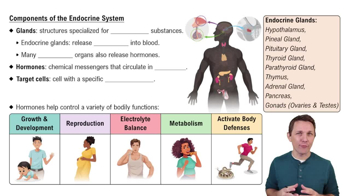
 7:06
7:06