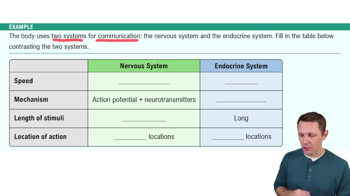
What is the primary function of the endocrine system?
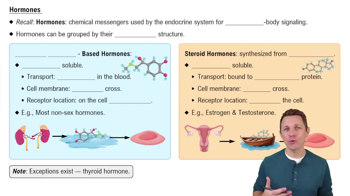
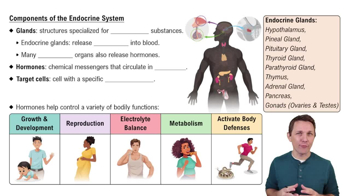
The endocrine system produces about 30 different hormones that control and coordinate body processes by altering metabolic activities of multiple tissues and organs.
Name the four main mechanisms of intercellular communication.
Direct communication, paracrine communication, endocrine communication, and synaptic communication.
What is the difference between endocrine and exocrine cells?
Endocrine cells release hormones into extracellular fluid and bloodstream, while exocrine cells release secretions through ducts.
Define down-regulation and up-regulation in hormone sensitivity.
Down-regulation decreases hormone receptors when hormone levels are high, reducing sensitivity. Up-regulation increases receptors when hormone levels are low, increasing sensitivity.
What are the three types of stimuli that control hormone secretion?
Humoral stimuli (changes in extracellular fluid), hormonal stimuli (arrival or removal of hormones), and neural stimuli (neurotransmitters).
What hormones are released by the anterior pituitary gland?
How does the hypothalamus regulate the anterior pituitary gland?
By secreting releasing hormones (RH) that stimulate and inhibiting hormones (IH) that prevent hormone synthesis and secretion.
What are the main functions of growth hormone (GH)?
Stimulates tissue growth by promoting amino acid uptake, cell division, triglyceride breakdown, and glycogen breakdown.
What hormones are secreted by the posterior pituitary gland?
Antidiuretic hormone (ADH) and oxytocin (OXT).
Where is the thyroid gland located and what are its main hormones?
Located inferior to the thyroid cartilage of the larynx; main hormones are thyroxine (T4) and triiodothyronine (T3).
What is the role of thyroglobulin in thyroid hormone synthesis?
Thyroglobulin is a protein synthesized by follicle cells that contains tyrosine, the building block for thyroid hormones.
How do thyroid hormones affect cellular metabolism?
They activate genes involved in glycolysis and ATP production, causing a calorigenic effect that increases energy consumption and heat generation.
What hormone do C cells in the thyroid gland produce and what is its function?
Calcitonin (CT), which helps regulate blood calcium levels by stimulating calcium excretion by kidneys and preventing calcium absorption in the digestive tract.
Where are the parathyroid glands located and what hormone do they secrete?
Embedded in the posterior surface of the thyroid gland; they secrete parathyroid hormone (PTH) in response to low blood calcium.
What are the major effects of parathyroid hormone (PTH)?
Stimulates osteoclasts to release calcium, enhances kidney calcium reabsorption, and stimulates calcitriol production to increase calcium absorption in the digestive tract.
Describe the structure and hormone production of the adrenal glands.
Located on top of kidneys; adrenal cortex produces corticosteroids, and adrenal medulla produces catecholamines (epinephrine and norepinephrine).
What are the three zones of the adrenal cortex and their primary hormones?
Zona glomerulosa (mineralocorticoids), zona fasciculata (glucocorticoids), and zona reticularis (androgens).
What effects do epinephrine and norepinephrine have when secreted by the adrenal medulla?
They mobilize glycogen and fats for energy, increase heart rate and contraction strength, and prepare the body for 'fight or flight' responses.
Where is the pineal gland located and what hormone does it produce?
Located in the posterior roof of the third ventricle; produces melatonin which influences circadian rhythms and inhibits reproductive functions.
What are the endocrine functions of the pancreas?
Pancreatic islets produce insulin (beta cells), glucagon (alpha cells), somatostatin (delta cells), and pancreatic polypeptide (PP cells) to regulate blood glucose.
How does insulin affect blood glucose levels?
Insulin accelerates glucose uptake, use, glycogen formation, protein synthesis, and triglyceride formation, lowering blood glucose.
How does glucagon affect blood glucose levels?
Glucagon stimulates glycogen breakdown, triglyceride breakdown, and glucose production in the liver, raising blood glucose.
What characterizes type 1 diabetes mellitus?
Inadequate insulin production by pancreatic beta cells, requiring insulin injections; usually develops in children and young adults.
What characterizes type 2 diabetes mellitus?
Normal or high insulin production but tissues are insulin resistant; often associated with obesity and treated with weight loss.
What are common complications of untreated diabetes mellitus?
Kidney degeneration, diabetic retinopathy, early heart attacks, peripheral neuropathies, tissue damage, and possible amputations.
Define antagonistic, synergistic, permissive, and integrative hormone interactions.
Antagonistic: hormones oppose each other; synergistic: additive effects; permissive: one hormone needed for another's effect; integrative: complementary but different effects.
What are the three phases of the general adaptation syndrome (GAS) in response to stress?
Alarm phase (immediate response), resistance phase (long-term adaptation), and exhaustion phase (failure of homeostasis).
Which hormones dominate the alarm and resistance phases of GAS?
Epinephrine dominates the alarm phase; glucocorticoids dominate the resistance phase.
 Back
 7:06