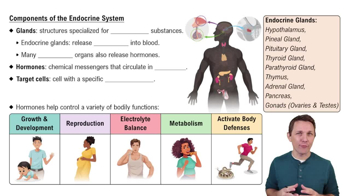
What are the main functions controlled by the endocrine system?
Reproduction, growth and development, maintenance of electrolyte, water, and nutrient balance, regulation of metabolism and energy, and mobilization of body defenses.
Difference between endocrine and exocrine glands?
Endocrine glands produce hormones and lack ducts; exocrine glands secrete nonhormonal substances through ducts to membrane surfaces.
What are autocrines and paracrines?
Autocrines act on the same cell that secretes them; paracrines affect nearby cells. Neither are considered true hormones.
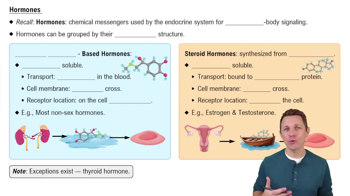
Two main chemical classes of hormones?
Amino acid-based hormones (amines, peptides, proteins) and steroid hormones (gonadal and adrenocortical hormones).
How do amino acid-based hormones typically act on target cells?
They bind to plasma membrane receptors and use G protein second messengers to alter cell activity.
How do steroid hormones act on target cells?
They diffuse through the plasma membrane and bind to intracellular receptors to directly activate genes.
What factors determine target cell activation by hormones?
Blood hormone levels, number of receptors on target cells, and receptor affinity for the hormone.
What is up-regulation and down-regulation in hormone receptors?
Up-regulation is an increase in receptor numbers; down-regulation is a decrease, affecting cell sensitivity.
Three types of stimuli that control hormone release?
Humoral (changes in blood ions/nutrients), neural (nerve fibers stimulate release), and hormonal (hormones stimulate other hormones).
What is the role of the hypothalamus in endocrine control?
It produces releasing and inhibiting hormones that regulate the anterior pituitary and synthesizes neurohormones stored in the posterior pituitary.
Functions of antidiuretic hormone (ADH)?
Regulates water balance by promoting kidney tubule water reabsorption; inhibited by alcohol and diuretics.
What hormones are produced by the anterior pituitary?
Role of calcitonin produced by thyroid parafollicular cells?
Lowers blood calcium by inhibiting osteoclast activity and stimulating calcium uptake into bone.
Function of parathyroid hormone (PTH)?
Increases blood calcium by stimulating bone resorption, enhancing kidney calcium reabsorption, and activating vitamin D for intestinal absorption.
Three layers of the adrenal cortex and their hormones?
Zona glomerulosa (mineralocorticoids like aldosterone), zona fasciculata (glucocorticoids like cortisol), zona reticularis (gonadocorticoids like androgens).
Main effects of aldosterone?
Stimulates sodium reabsorption and water retention by kidneys, and potassium elimination to regulate blood volume and pressure.
 Back
 7:06