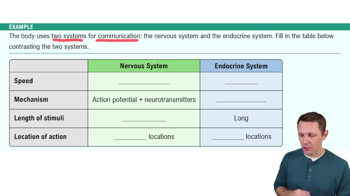
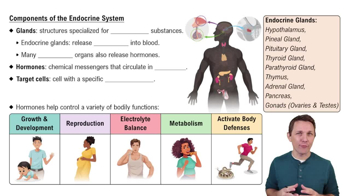
An endocrine gland is a ductless organ or cell group that secretes hormones directly into the extracellular fluid or bloodstream to regulate body functions.
What are the two main types of endocrine glands?
Classic endocrine glands are whole organs like the pituitary and thyroid, while diffuse endocrine glands are scattered cells within other organs such as the hypothalamus and skin.
What is a hormone?
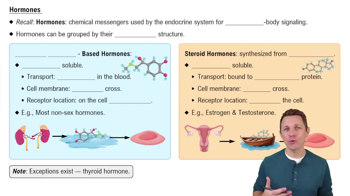
A hormone is a chemical messenger secreted by endocrine cells that travels through the bloodstream to target specific cells with unique receptors.
List four key principles of hormonal signaling.
Hormones act in small quantities (picomolar to nanomolar), have limited duration, target distant specific cells, and bind unique receptors for specificity.
What are the three main mechanisms by which hormones control target cells?
Hormones regulate rates of enzymatic reactions, transport of materials across membranes, and gene expression with protein synthesis.
Name four types of hormone interactions that influence hormone effects.
Additive, synergistic, permissive, and antagonistic interactions affect how hormones influence target cells.
What is the difference between additive and synergistic hormone effects?
Additive effects sum the individual hormone actions, while synergistic effects produce a response greater than the sum of individual effects.
Define permissive hormone action.
A permissive hormone has little or no effect alone but enables another hormone to exert its full effect when both are present.
Give an example of antagonistic hormones and their opposing actions.
Insulin promotes glycogen synthesis in the liver, while glucagon stimulates glycogen breakdown, opposing each other's effects.
What are the three main hormone types based on chemical structure?
Peptide hormones (amino acid chains), steroid hormones (cholesterol-derived), and amine hormones (derived from single amino acids).
Describe key traits of peptide hormones.
Peptide hormones are water-soluble, made of 3-200 amino acids, synthesized on rough ER, stored in vesicles, and have short half-lives.
How are steroid hormones synthesized and stored?
Steroid hormones are synthesized on demand from cholesterol in the smooth ER and are not stored in vesicles.
How do water-soluble and lipid-soluble hormones differ in blood transport?
Water-soluble hormones circulate freely in plasma, while lipid-soluble hormones bind to transport proteins for circulation.
Where are receptors located for peptide vs. steroid hormones?
Peptide hormones bind to cell surface receptors; steroid hormones bind to intracellular receptors in the cytoplasm or nucleus.
What is the general mechanism of action for peptide hormones?
Peptide hormones bind surface receptors, activate second messenger systems, and rapidly modify existing proteins or gene expression.
Explain the synthesis process of peptide hormones starting from preprohormones.
Preprohormones are synthesized on rough ER, cleaved to prohormones, processed in Golgi, packaged into vesicles, and released as active hormones.
What is the significance of C-peptide in insulin production?
C-peptide is cleaved from proinsulin during insulin synthesis and can be measured clinically to assess endogenous insulin production.
How does insulin regulate glucose uptake in target cells?
Insulin signaling moves GLUT4 glucose transporters to the cell membrane, increasing glucose uptake by skeletal muscle and other cells.
What are the main endocrine glands controlled by the hypothalamus and pituitary gland?
The hypothalamus controls the anterior pituitary, which secretes hormones regulating thyroid, adrenal, gonads, and growth functions.
What hormones are secreted by the posterior pituitary and their functions?
Oxytocin stimulates smooth muscle contraction and milk ejection; antidiuretic hormone (ADH) reduces water loss in urine.
What is the role of the hypothalamic-pituitary portal system?
It transports releasing and inhibiting hormones from the hypothalamus directly to the anterior pituitary to regulate hormone secretion.
What are the five cell types in the anterior pituitary and their primary hormones?
 Back
 7:06