Skip to main content
Anatomy & Physiology
My Course
Learn
Exam Prep
AI Tutor
Study Guides
Textbook Solutions
Flashcards
Explore
Try the app
My Course
Learn
Exam Prep
AI Tutor
Study Guides
Textbook Solutions
Flashcards
Explore
Try the app
Back
Endocrine System Review - Anatomy & Physiology
You can tap to flip the card.
What do nervous and endocrine systems both regulate?
You can tap to flip the card.
👆
What do nervous and endocrine systems both regulate?
Body functions and homeostasis through intercellular chemical communication.
Track progress
Control buttons has been changed to "navigation" mode.
1/59
Recommended videos
Guided course
7:06
Components of the Endocrine System
15432
views
458
rank
Guided course
6:20
Hormones
11759
views
286
rank
Guided course
3:33
Introduction to the Endocrine System Example 1
16546
views
491
rank
1
comments
Terms in this set (59)
Hide definitions
What do nervous and endocrine systems both regulate?
Body functions and homeostasis through intercellular chemical communication.
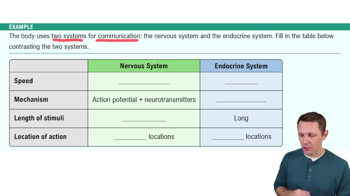
What chemical messenger does the nervous system use?
Neurotransmitters released by neurons.
What chemical messenger does the endocrine system use?
Hormones released into the bloodstream.
Which system usually responds faster?
The nervous system.
Which system usually produces longer-lasting effects?
The endocrine system.
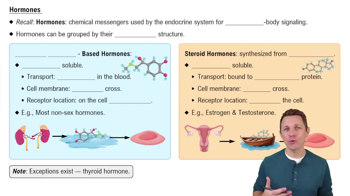
What are the major chemical classes of hormones?
Steroids, peptides/proteins, and amino-acid derivatives.
What molecule are steroid hormones derived from?
Cholesterol.
Are steroid hormones lipid-soluble or water-soluble?
Lipid-soluble.
Give examples of steroid hormones.
Cortisol, aldosterone, estrogen, progesterone, and testosterone.
What are peptide hormones composed of?
Chains of amino acids.
Give examples of peptide/protein hormones.
Insulin, ADH, growth hormone, and PTH.
What are amino-acid derivative hormones made from?
Modified individual amino acids, commonly tyrosine or tryptophan.
Give examples of amino-acid derivative hormones.
Thyroid hormones, epinephrine, norepinephrine, and melatonin.
Which hormones usually require blood carrier proteins?
Lipid-soluble hormones, including steroid and thyroid hormones.
Which hormones usually circulate freely in plasma?
Most water-soluble peptide and catecholamine hormones.
What is the hypothalamus's endocrine function?
Controls the pituitary and produces ADH and oxytocin.
What major hormones come from the anterior pituitary?
GH, TSH, ACTH, FSH, LH, and prolactin.
What hormones are released by the posterior pituitary?
ADH and oxytocin.
What hormones does the thyroid produce?
T3, T4, and calcitonin.
What hormone do the parathyroid glands produce?
Parathyroid hormone (PTH).
Where do water-soluble hormones bind receptors?
On the target cell's plasma membrane.
Where do lipid-soluble hormones usually bind receptors?
Inside the target cell, in the cytoplasm or nucleus.
What is a second messenger?
An intracellular molecule that relays a signal from a membrane receptor.
What is a common second messenger?
Cyclic AMP (cAMP).
What endocrine structure directly controls the pituitary?
The hypothalamus.
How does the hypothalamus control the anterior pituitary?
With releasing and inhibiting hormones through the portal system.
What is negative feedback?
The final response reduces the original stimulus or hormone secretion.
Why is negative feedback important?
It stabilizes hormone levels and helps maintain homeostasis.
What is the HPT axis?
Hypothalamus TRH -> pituitary TSH -> thyroid T3/T4.
What is the HPA axis?
Hypothalamus CRH -> pituitary ACTH -> adrenal cortisol.
Where is the thyroid gland located?
Anterior neck, below the larynx and around the trachea.
What do thyroid follicular cells produce?
T3 and T4.
What is the main function of T3 and T4?
Increase metabolic activity and support growth and development.
What hormone stimulates the thyroid?
Thyroid-stimulating hormone (TSH).
What hormone do the adrenal cortex produce?
Aldosterone, cortisol, and adrenal androgens.
What hormones come from the adrenal medulla?
Epinephrine and norepinephrine.
What is the main function of insulin?
It lowers blood glucose by promoting glucose uptake and storage.
What is the main function of glucagon?
It raises blood glucose by stimulating glucose release from the liver.
What hormone is secreted by the pineal gland?
Melatonin.
What is the main function of melatonin?
It helps regulate circadian rhythms and the sleep-wake cycle.
What are the three major types of hormone interactions?
Permissive, synergistic, and antagonistic interactions.
What is a permissive hormone interaction?
One hormone allows or enhances another hormone's effect.
What is a synergistic hormone interaction?
Two or more hormones work together to produce a greater effect.
What is an antagonistic hormone interaction?
Two hormones produce opposing physiological effects.
What are the three major stimuli for hormone secretion?
Humoral, neural, and hormonal stimuli.
What is a humoral stimulus?
A change in blood levels of ions or nutrients that triggers hormone secretion.
What is a neural stimulus?
A nerve impulse that directly stimulates hormone secretion.
What is a hormonal stimulus?
One hormone stimulates another endocrine gland to release hormones.
How do hormones travel to their target cells?
They circulate through the bloodstream.
What is diabetes mellitus?
A group of disorders characterized by chronic high blood glucose due to inadequate insulin action.
What causes type 1 diabetes mellitus?
Autoimmune destruction of pancreatic beta cells.
What is hypothyroidism?
Insufficient thyroid hormone activity.
What is hyperthyroidism?
Excessive thyroid hormone activity.
What is Cushing syndrome?
A condition caused by excessive cortisol exposure.
What is Addison disease?
Primary adrenal insufficiency caused by adrenal cortex dysfunction.
What causes gigantism?
Excess growth hormone before the growth plates close.
What causes acromegaly?
Excess growth hormone in adulthood.
What is hyperparathyroidism?
Excessive secretion of parathyroid hormone.
What is hypoparathyroidism?
Insufficient secretion of parathyroid hormone.
 BackBack
 7:06