Narrow passages in the nasal cavity that help direct airflow and increase surface area for warming and humidifying air.
Conchae
Curved bony ridges in the nasal cavity that create turbulence to warm, moisten, and filter inhaled air.
Pharynx
A muscular tube that connects the nasal and oral cavities to the larynx and esophagus; involved in both respiration and digestion.
Pharyngotympanic tube
Also called the auditory tube; connects the middle ear to the pharynx to equalize air pressure.
Palates (soft, hard, uvula)
The hard palate forms the bony roof of the mouth; the soft palate is muscular and closes off the nasal passages during swallowing; the uvula hangs from the soft palate.
Larynx
Voice box containing the vocal cords; includes structures like the vestibular fold, vocal cords, epiglottis, glottis, and thyroid cartilage.
Vestibular fold
Also called false vocal cords; protect the true vocal cords and help close the larynx during swallowing.
Vocal cords
True vocal cords that vibrate to produce sound when air passes through the glottis.
Epiglottis
A flap of cartilage that covers the glottis during swallowing to prevent food from entering the trachea.
Glottis
The opening between the vocal cords through which air passes.
Thyroid cartilage
The largest cartilage of the larynx; forms the laryngeal prominence (Adam's apple).
Cricoid cartilage
A ring-shaped cartilage located below the thyroid cartilage; provides support to the larynx.
Trachea
A flexible tube supported by tracheal cartilages that conducts air from the larynx to the bronchi.
Tracheal cartilages
C-shaped rings of hyaline cartilage that keep the trachea open and prevent collapse.
Esophagus
A muscular tube posterior to the trachea that transports food from the pharynx to the stomach.
Thyroid gland
An endocrine gland located anterior to the trachea that produces thyroid hormones.
Hyoid bone
A U-shaped bone in the neck that supports the tongue and is an attachment site for muscles of swallowing.
Tongue
A muscular organ in the mouth involved in taste, speech, and manipulating food.
Laryngeal prominence
The visible projection of the thyroid cartilage, commonly known as the Adam's apple.
Carina
The ridge of cartilage at the base of the trachea where it divides into the left and right primary bronchi.
Bronchi
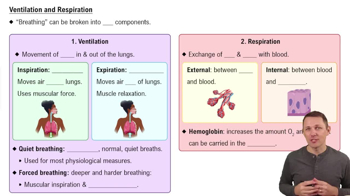
The two main airways branching from the trachea that lead into each lung.
Bronchiole
Smaller branches of the bronchi that lead to the alveolar ducts and alveoli.
Lobes
Distinct sections of the lungs; the right lung has three lobes, the left lung has two.
Alveoli
Tiny air sacs in the lungs where gas exchange occurs between air and blood.
Elastic fibers
Fibers in lung tissue that allow the lungs to stretch and recoil during breathing.
Smooth muscle fibers
Muscle fibers in the walls of bronchi and bronchioles that regulate airway diameter.
Mucous glands of the bronchi
Glands that secrete mucus to trap particles and moisten the airway lining.
Pulmonary artery
Carries deoxygenated blood from the right ventricle to the lungs for oxygenation.
Pulmonary vein
Carries oxygenated blood from the lungs back to the left atrium of the heart.
Bronchiolar artery
Supplies oxygenated blood to the lung tissue itself, including the bronchi and connective tissue.
Alveolar capillary network
A dense network of capillaries surrounding alveoli where gas exchange occurs.
Alveolar pores
Small openings between adjacent alveoli that allow air pressure to equalize and collateral ventilation.
 Back
 4:28