Skip to main content
Anatomy & Physiology
My Course
Learn
Exam Prep
AI Tutor
Study Guides
Textbook Solutions
Flashcards
Explore
Try the app
My Course
Learn
Exam Prep
AI Tutor
Study Guides
Textbook Solutions
Flashcards
Explore
Try the app
Back
Histology of Endocrine Glands - Pituitary, Thyroid, Adrenal, Pancreas, and Thymus
You can tap to flip the card.
What are the two main parts of the pituitary gland?
You can tap to flip the card.
👆
What are the two main parts of the pituitary gland?
The pituitary gland consists of the
anterior pituitary
(glandular epithelial tissue) and the
posterior pituitary
(nervous tissue).
Track progress
Control buttons has been changed to "navigation" mode.
1/20
Recommended videos
7:06
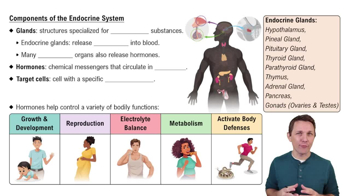
Components of the Endocrine System
15166
views
458
rank
6:20
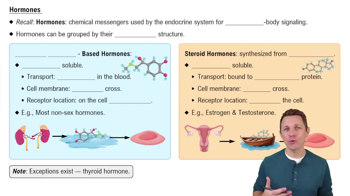
Hormones
11558
views
284
rank
3:33
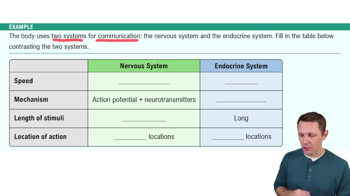
Introduction to the Endocrine System Example 1
16338
views
490
rank
1
comments
Terms in this set (20)
Hide definitions
What are the two main parts of the pituitary gland?
The pituitary gland consists of the
anterior pituitary
(glandular epithelial tissue) and the
posterior pituitary
(nervous tissue).
What type of tissue composes the anterior pituitary?
The anterior pituitary is composed of
glandular epithelial tissue
responsible for hormone secretion.
What type of tissue composes the posterior pituitary?
The posterior pituitary is composed of
nervous tissue
and stores hormones produced by the hypothalamus.
What are pituicytes and where are they found?
Pituicytes
are specialized glial cells found in the posterior pituitary that support nerve fibers.
Name the main components of the thyroid gland histology.
The thyroid gland contains
follicular epithelium
,
colloid
inside follicles, and
parafollicular cells
(C cells).
What is the function of thyroid follicular cells?
Thyroid follicular cells produce and secrete thyroid hormones and surround the colloid in follicles.
What do parafollicular cells (C cells) in the thyroid gland secrete?
Parafollicular cells
secrete
calcitonin
, which helps regulate calcium levels.
What are the main zones of the adrenal cortex?
The adrenal cortex has three zones:
zona glomerulosa
,
zona fasciculata
, and
zona reticularis
.
What hormone is primarily produced by the zona glomerulosa?
The zona glomerulosa produces
mineralocorticoids
, mainly
aldosterone
.
What hormone is primarily produced by the zona fasciculata?
The zona fasciculata produces
glucocorticoids
, mainly
cortisol
.
What hormone is primarily produced by the zona reticularis?
The zona reticularis produces
androgens
, which are sex hormone precursors.
What is the adrenal medulla composed of and what does it secrete?
The adrenal medulla is composed of
chromaffin cells
that secrete
catecholamines
like epinephrine and norepinephrine.
What are the two main tissue types in the pancreas?
The pancreas contains
acinar tissue
(exocrine) and
pancreatic islets
(endocrine).
What is the function of pancreatic acinar tissue?
Pancreatic acinar tissue produces digestive enzymes secreted into ducts.
What cells are found in pancreatic islets and what do they secrete?
Pancreatic islets contain
alpha cells
(glucagon),
beta cells
(insulin), and other endocrine cells.
What is the thymus primarily composed of histologically?
The thymus is composed of
thymic lobules
with a cortex rich in maturing
T-lymphocytes
and a medulla containing
Hassall's corpuscles
.
What are Hassall's corpuscles?
Hassall's corpuscles are concentric structures found in the thymic medulla involved in T-cell maturation.
What is the role of the thymus in the immune system?
The thymus is essential for the maturation and differentiation of
T-lymphocytes
(T-cells).
What is the capsule in endocrine glands?
The capsule is a connective tissue layer that surrounds endocrine glands, providing protection and structural support.
How can you distinguish the anterior pituitary from the posterior pituitary histologically?
The anterior pituitary appears more cellular with glandular epithelial cells, while the posterior pituitary has fewer cells and more nerve fibers.
 BackBack
 7:06