Skip to main content
Anatomy & Physiology
My Course
Learn
Exam Prep
AI Tutor
Study Guides
Textbook Solutions
Flashcards
Explore
Try the app
My Course
Learn
Exam Prep
AI Tutor
Study Guides
Textbook Solutions
Flashcards
Explore
Try the app
Back
Introduction to the Endocrine System /A& P II
You can tap to flip the card.
What are the two main types of chemical messengers used by the endocrine system?
You can tap to flip the card.
👆
What are the two main types of chemical messengers used by the endocrine system?
Endocrine
and
neurotransmitter
systems.
Track progress
Control buttons has been changed to "navigation" mode.
1/29
Recommended videos
7:06
Components of the Endocrine System
13701
views
416
rank
6:20
Hormones
10448
views
258
rank
3:33
Introduction to the Endocrine System Example 1
14949
views
442
rank
1
comments
Terms in this set (29)
Hide definitions
What are the two main types of chemical messengers used by the endocrine system?
Endocrine
and
neurotransmitter
systems.
What are the four types of chemical messengers based on their signaling method?
Endocrine
,
paracrine
,
autocrine
, and
neurotransmitter
.
How do endocrine chemical messengers travel to their target cells?
They diffuse into the
bloodstream
and act on specific
target cells
.
What is the difference between autocrine and paracrine signaling?
Autocrine
acts on the same cell that secretes it;
paracrine
acts on nearby cells.
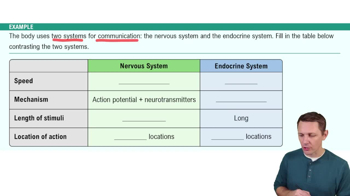
What is the main difference in speed between the nervous and endocrine systems?
Nervous system is
fast
(milliseconds), endocrine system is
slow
(hours to days).
What are the main components of the endocrine system?
Glands
that secrete hormones into the bloodstream and
hormones
that regulate body functions.
What are the two types of glands based on secretion method?
Exocrine glands
secrete through ducts;
endocrine glands
secrete hormones into blood.
Why is the pancreas called a dual gland?
It acts as an
exocrine gland
by secreting digestive enzymes and as an
endocrine gland
by secreting hormones.
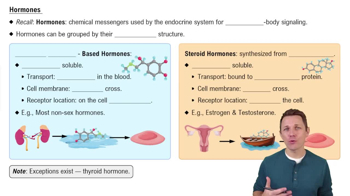
What are the three chemical classes of hormones based on solubility?
Amine, peptide/protein
(water soluble) and
steroid
(lipid soluble).
How do lipid-soluble hormones travel in the blood?
They bind to
plasma carrier proteins
for transport.
Where are receptors located for lipid-soluble hormones?
Inside the
cytoplasm or nucleus
of the target cell.
Where are receptors located for water-soluble hormones?
On the
cell membrane
of the target cell.
What is the second messenger commonly activated by water-soluble hormones?
cAMP
(cyclic adenosine monophosphate).
What is the process called when protein kinases add phosphate groups to inactive proteins?
Phosphorylation
.
What is up-regulation in hormone receptor activity?
Increase in receptor number when hormone levels are low.
What is down-regulation in hormone receptor activity?
Decrease in receptor number when hormone levels are high.
What is the term for maintaining internal stability by hormones?
Homeostasis
.
What are the three types of signals that stimulate endocrine glands?
Humoral
,
neural
, and
hormonal
stimuli.
What is an example of a humoral stimulus?
Blood glucose levels stimulating insulin release.
What is the difference between positive and negative feedback in hormone regulation?
Negative feedback decreases hormone secretion; positive feedback increases it.
Which hormone is released by the posterior pituitary in response to infant suckling?
Oxytocin
.
What hormone stimulates milk production in mammary glands?
Prolactin
.
What hormone regulates water reabsorption in kidneys?
Antidiuretic hormone (ADH)
.
What hormone is secreted by the adrenal medulla during fight or flight response?
Adrenaline (epinephrine)
.
What hormone regulates calcium levels by increasing blood calcium?
Parathyroid hormone (PTH)
.
What hormone lowers blood calcium levels?
Calcitonin
.
What is the main function of gonadotropins?
Stimulate ovaries and testes to produce sex hormones.
What hormone regulates the internal biological clock?
Melatonin
from the pineal gland.
What hormone from the thymus aids in T cell maturation?
Thymosin
.
 BackBack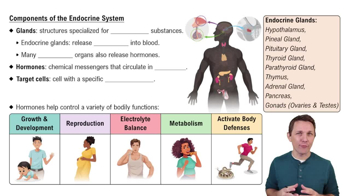
 7:06
7:06