 Back
BackLab exam #1
 02:44
02:44
Terms in this set (24)
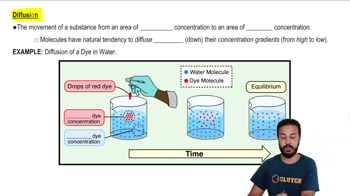
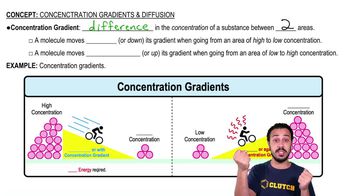
Diffusion is the movement of molecules from an area of higher concentration to an area of lower concentration due to random molecular motion.
Osmosis is the diffusion of water across a selectively permeable membrane.
Molecule size, concentration gradient, and temperature affect diffusion rate.
Smaller molecules diffuse faster than larger molecules.
A greater concentration gradient increases the rate of diffusion.
Higher temperatures increase molecular motion, thus increasing diffusion rate.
Oxygen and carbon dioxide exchange in the lungs occurs by diffusion.
An acid is a substance that increases the concentration of hydrogen ions (H+) in solution.
A base is a substance that decreases hydrogen ion concentration, often by providing hydroxide ions (OH-).
pH is defined as \(-\log[H_3O^+]\), the negative logarithm of hydronium ion concentration.
Blood has a typical pH of about 7.4, which is slightly basic.
Gastric juice has a very acidic pH, around 1 to 2.
Pure water has a neutral pH of 7.
Each enzyme has an optimal pH range; extreme pH values can denature enzymes and reduce their activity.
Pepsin works best at pH 2, while amylase works best at pH 7.
The independent variable is the variable manipulated by the experimenter.
The dependent variable is the variable measured or observed in an experiment.
A control variable is kept constant to ensure a fair test.
The control group does not receive the experimental treatment and is used for comparison.
pH is the independent variable.
Enzyme activity is the dependent variable.
The x-axis usually represents the independent variable.
The y-axis usually represents the dependent variable.
Look for trends such as increases, decreases, or plateaus.