What are the three main parts of the lymphatic system?
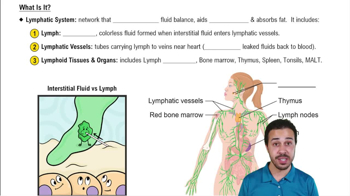
A network of lymphatic vessels, lymph, and lymph nodes.
What is lymph?
Interstitial fluid that has entered lymphatic vessels.
What is the function of the lymphatic system?
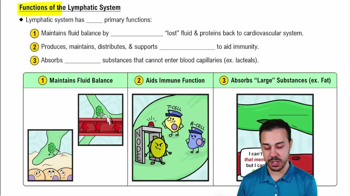
Returns interstitial fluid and leaked plasma proteins back to the blood and provides the structural basis of the immune system.
How do lymphatic vessels differ from blood vessels?
Lymphatic vessels form a one-way system that flows toward the heart and have thinner walls with more valves.
What are lymphatic capillaries and their special features?
Blind-ended tubes with overlapping endothelial cells forming one-way minivalves; very permeable to cell debris, pathogens, and cancer cells.
Where are lymphatic capillaries absent?
Bones, teeth, bone marrow, and the central nervous system.
What are lacteals?
Specialized lymphatic capillaries in the intestinal mucosa that absorb digested fats and deliver fatty lymph (chyle) to the blood.
What are the two main lymphatic ducts and their drainage areas?
Right lymphatic duct drains the right upper arm and right side of the head and thorax; thoracic duct drains the rest of the body.
How is lymph transported through lymphatic vessels?
By skeletal muscle milking, thoracic pressure changes during breathing, valves preventing backflow, arterial pulsations, and smooth muscle contractions.
What are the main lymphoid cells involved in immunity?
T lymphocytes (T cells) and B lymphocytes (B cells).
What are the functions of T cells and B cells?
T cells manage immune response and destroy foreign cells; B cells produce plasma cells that secrete antibodies.
What is the role of macrophages and dendritic cells in lymphoid tissue?
Macrophages phagocytize foreign substances and help activate T cells; dendritic cells capture antigens and deliver them to lymph nodes.
What are the two main functions of lymph nodes?
Filter lymph by destroying microorganisms and debris; activate lymphocytes to mount an immune response.
What are the primary functions of the spleen?
Lymphocyte proliferation, immune surveillance, blood cleansing of aged cells and debris, and blood platelet storage.
How does the thymus differ from other lymphoid organs?
It functions strictly in T lymphocyte maturation and does not directly fight antigens.
What are the four types of tonsils and their function?
Palatine, lingual, pharyngeal, and tubal tonsils; they form a ring around the pharynx to gather and remove pathogens entering via food or air.
What are Peyer's patches and their role?
Clusters of lymphoid follicles in the small intestine wall that destroy bacteria and generate memory lymphocytes.
What are the two intrinsic defense systems of immunity?
Innate (nonspecific) defense system and adaptive (specific) defense system.
What are the components of innate surface barriers?
Skin and mucous membranes with protective chemicals like skin acidity, dermcidin in sweat, HCl in the stomach, lysozyme in saliva, and mucus.
What are the main internal innate defenses?
Phagocytes, natural killer cells, inflammation, antimicrobial proteins, and fever.
What is opsonization in phagocytosis?
Coating of pathogens by complement proteins or antibodies to facilitate phagocyte adherence.
What are the cardinal signs of acute inflammation?
Redness, heat, swelling, pain, and sometimes impairment of function.
What are the steps of phagocyte mobilization during inflammation?
Leukocytosis, margination, diapedesis, and chemotaxis.
How do interferons protect against viral infections?
They are secreted by infected cells and induce neighboring cells to produce antiviral proteins that block viral reproduction.
What are the benefits of a moderate fever?
Causes liver and spleen to sequester iron and zinc, and increases metabolic rate to speed up repair.
What are the two arms of adaptive immunity?
Humoral (antibody-mediated) immunity by B cells and cellular (cell-mediated) immunity by T cells.
What are antigens?
Substances that mobilize adaptive defenses and provoke an immune response.
What is the difference between active and passive humoral immunity?
Active immunity involves B cells producing antibodies after antigen exposure; passive immunity involves receiving antibodies without antigen challenge.
What is the structure of an antibody?
A T- or Y-shaped monomer with two identical heavy chains and two identical light chains, with variable regions forming antigen-binding sites.
What are the main functions of antibodies?
Neutralization, agglutination, precipitation, and complement fixation to inactivate and tag antigens.
What are the major types of T cells and their roles?
Helper T cells activate immune responses; cytotoxic T cells kill infected or abnormal cells; regulatory T cells suppress immune responses; memory T cells provide long-term immunity.
 Back
Back
 3:32
3:32