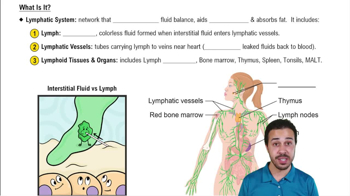
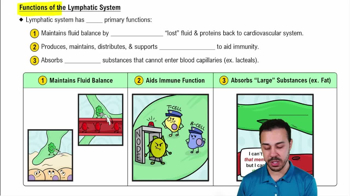
Cells, tissues, and organs responsible for defending the body against environmental hazards and internal threats, including lymph, lymphatic vessels, lymphoid tissues, and lymphocytes.
What are the main types of lymphocytes?
T-cells, B-cells, and Natural Killer (NK) cells.
What is the function of lymphatic vessels?
They begin in peripheral tissues and end at veins, transporting lymph fluid back to the cardiovascular system.
What are lymphoid tissues and organs?
Lymph nodes, thymus, tonsils, Peyer's patches, MALT, and spleen.
How do lymphatic capillaries differ from blood capillaries?
Lymphatic capillaries originate as pockets, have larger diameters, thinner walls, and a larger shape, allowing fluid and large molecules to enter.
What prevents backflow in small lymphatic vessels?
Valves similar to veins that prevent backflow because lymph pressure is minimal.
What is the thoracic duct and its function?
A major lymphatic trunk that collects lymph from the body inferior to the diaphragm and the left side superior to the diaphragm, emptying into the left subclavian vein.
What is the role of the right lymphatic duct?
It collects lymph from the right jugular, right subclavian, and right bronchomediastinal trunks and empties into the right subclavian vein.
What is lymphedema?
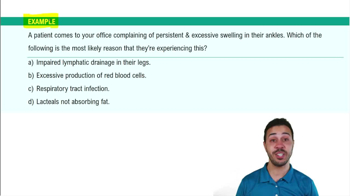
Blockage of lymphatic drainage causing increased interstitial fluids and a higher chance of infections in the affected area.
What are the primary lymphoid organs?
Thymus gland and bone marrow, where lymphocytes mature.
What are secondary lymphoid organs?
Lymph nodes, spleen, tonsils, Peyer's patches, and MALT where lymphocytes are activated.
What is the function of lymph nodes?
They purify lymph by removing antigens and present them to lymphocytes, acting as an early warning system for infections.
What is the thymus gland's role in immunity?
It is where T-cells mature and is large in newborns and children but shrinks with age.
What are the functions of the spleen?
Removal of abnormal blood cells, storage of iron, and initiation of immune responses by B and T cells.
What is phagocytosis in the immune system?
The process by which macrophages engulf and digest pathogens and present antigens to lymphocytes.
What is immunological surveillance?
NK cells monitor and destroy virus-infected cells, tumor cells, and parasite-infected cells.
What are interferons and their function?
Small proteins released by infected cells that signal neighboring cells to inhibit viral replication and activate immune cells.
What is the role of Helper T cells?
They stimulate T and B cell responses in specific/adaptive immunity.
What is the role of Cytotoxic T cells?
They perform direct cellular attacks on infected or abnormal cells.
What is the role of Regulatory T cells?
They moderate and regulate T cell responses to prevent overactivity.
How do B cells respond to antigens?
They differentiate into plasma cells that produce antibodies specific to antigens.
 Back
 3:32