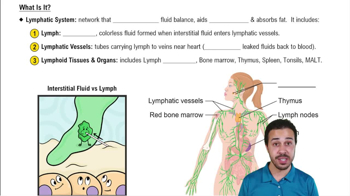
Lymphatic vessels transport lymph, and lymphatic tissues/organs (tonsils, lymph nodes, spleen, thymus) house immune cells and filter pathogens.
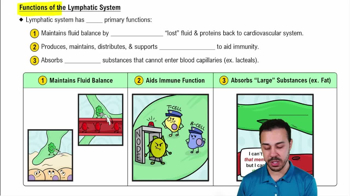
Primary functions of the lymphatic system
Regulates interstitial fluid volume, absorbs dietary fats, and supports immune functions by filtering pathogens and housing leukocytes.
How does lymph flow through the body?
Lymph flows in low-pressure vessels with valves preventing backflow, moved by muscle contractions and smooth muscle in vessel walls.
What causes lymphedema?
Severe swelling from excess interstitial fluid due to lymphatic vessel removal or blockage, such as after surgery or parasitic infection.
Structure and function of lymphatic capillaries
Blind-ended vessels with endothelial flaps allowing fluid, macrophages, bacteria, and cancer cells to enter lymph from tissues.
What is MALT and where is it found?
Mucosa-Associated Lymphatic Tissue protects mucous membranes in GI, respiratory, and genitourinary tracts; includes tonsils, Peyer's patches, and appendix.
Role of lymph nodes
Small bean-shaped clusters that filter lymph, contain B and T cells, macrophages, and dendritic cells; lymph enters via afferent and exits via efferent vessels.
Functions of the spleen's red and white pulp
Red pulp destroys old erythrocytes; white pulp contains leukocytes that filter pathogens from blood.
Role of the thymus in immunity
Site of T cell maturation and screening; secretes hormones to generate functional T cells; atrophies with age.
Three lines of immune defense
First line: surface barriers; second line: innate immunity; third line: adaptive immunity.
Characteristics of innate immunity
Nonspecific, rapid response to all pathogens; includes cells like macrophages, neutrophils, NK cells, and proteins like complement.
Classical (antibody-bound), lectin (microbial carbohydrates), and alternative (C3 cleavage) pathways activate complement proteins.
Functions of activated complement proteins
Cause cell lysis, enhance inflammation, neutralize viruses, opsonize pathogens, and clear immune complexes.
Role of cytokines in immunity
Regulate immune cell activity; examples include TNF (attracts phagocytes), interferons (inhibit viruses), and interleukins (stimulate leukocytes).
Phases of the inflammatory response
Release of mediators causing redness, heat, swelling, pain; followed by phagocyte response ingesting pathogens and debris.
How does fever aid immunity?
Elevated body temperature enhances phagocyte efficiency and recovery; pyrogens trigger hypothalamus to raise temperature.
Difference between cell-mediated and antibody-mediated immunity
Cell-mediated uses T cells to target infected or cancerous cells; antibody-mediated uses B cells and antibodies to neutralize pathogens.
Major Histocompatibility Complex (MHC) classes and functions
Class I MHC on all nucleated cells presents endogenous antigens to cytotoxic T cells; Class II MHC on APCs presents exogenous antigens to helper T cells.
Process of T cell activation
Dendritic cells present antigen on MHC to T cells, triggering clonal selection and differentiation into effector and memory T cells.
Functions of helper and cytotoxic T cells
Helper T cells secrete cytokines activating immune cells; cytotoxic T cells kill infected or abnormal cells via perforin and apoptosis enzymes.
Steps in B cell activation and antibody production
B cell binds antigen, presents it on MHC II, receives helper T cell cytokines, then divides into plasma cells (antibody producers) and memory B cells.
 Back
 3:32