Primary locations of lymphocyte production and distribution
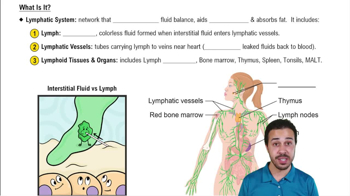
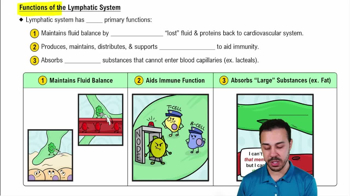
Lymphocytes are produced and distributed in lymphoid tissues (tonsils), lymphoid organs (spleen, thymus), and red bone marrow.
Pathway of lymphocyte circulation
Lymphocytes move from blood to interstitial fluid (lymph) through capillaries and return to venous blood via lymphatic vessels.
Function of lymph nodes
Lymph nodes monitor peripheral infections and respond before infections reach vital organs of the trunk.
Difference between innate and adaptive immunity
Innate immunity is nonspecific and present at birth; adaptive immunity develops after exposure to specific antigens.
Types of adaptive immunity
Active immunity develops after antigen exposure; passive immunity is produced by transfer of antibodies from another source.
Physical barriers in innate immunity
Physical barriers such as skin and mucous membranes prevent hazardous organisms and materials from entering the body.
Role of phagocytes in innate immunity
Phagocytes engulf pathogens and cell debris to help defend the body against infection.
Function of natural killer (NK) cells
NK cells destroy abnormal cells by releasing perforins and granzymes, inducing apoptosis.
Purpose of interferons
Interferons are chemical messengers released by activated lymphocytes, macrophages, or virus-infected cells to coordinate antiviral defenses.
Complement system overview
The complement system is a group of plasma proteins produced mainly by the liver that assist antibodies in destroying pathogens.
Effects of complement activation
Complement activation leads to cell lysis, enhanced inflammation, neutralization of viruses, enhanced phagocytosis, and clearance of immune complexes.
Inflammation response steps
Inflammation involves increased blood flow, phagocyte activation, increased capillary permeability, complement activation, clotting, temperature rise, and activation of adaptive defenses.
Fever role in immunity
Fever elevates body temperature above 37.2°C to accelerate tissue metabolism and enhance body defenses.
T cell maturation process
T cells mature in the thymus, undergoing gene rearrangements to create diverse clones; the thymus screens and destroys non-functional clones.
Major histocompatibility complex (MHC) role
T cells interact only with antigen fragments bound to MHC molecules, which present antigens on cell surfaces.
Types of T cells in adaptive immunity
Helper T (TH) cells (CD4) assist other immune cells; cytotoxic T (TC) cells (CD8) kill infected or abnormal cells.
B cell function in antibody-mediated immunity
B cells have receptors for specific antigens and secrete antibodies that bind to the same antigen.
Clonal selection in B cells
A group of B cells binding a specific antigen forms a clone; upon activation, they proliferate and differentiate into plasma cells producing antibodies.
Antibody structure basics
Antibodies are proteins with variable regions that bind antigens and constant regions that mediate immune responses.
Active vs passive antibody-mediated immunity
Active immunity results from antigen exposure; passive immunity is gained by receiving antibodies from another source.
 Back
 3:32