Skip to main content
Anatomy & Physiology
My Course
Learn
Exam Prep
AI Tutor
Study Guides
Textbook Solutions
Flashcards
Explore
Try the app
My Course
Learn
Exam Prep
AI Tutor
Study Guides
Textbook Solutions
Flashcards
Explore
Try the app
Back
Lymphatic System and Lymphoid Organs - Anatomy & Physiology
You can tap to flip the card.
What are the three main parts of the lymphatic system?
You can tap to flip the card.
👆
What are the three main parts of the lymphatic system?
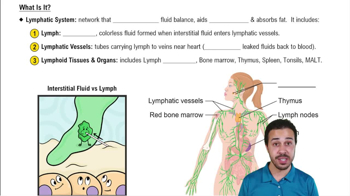
Network of lymphatic vessels, lymph (fluid in vessels), and lymph nodes that cleanse lymph.
Track progress
Control buttons has been changed to "navigation" mode.
1/24
Recommended videos
Guided course
3:32
Introduction to the Lymphatic System Example 2
5263
views
99
rank
Guided course
3:33
What Is It?
6913
views
182
rank
Guided course
3:57
Functions of the Lymphatic System
5883
views
137
rank
Terms in this set (24)
Hide definitions
What are the three main parts of the lymphatic system?
Network of lymphatic vessels, lymph (fluid in vessels), and lymph nodes that cleanse lymph.
What is the primary function of the lymphatic system?
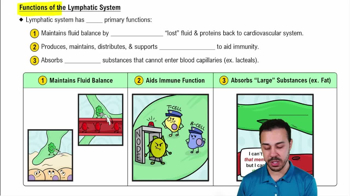
Returns interstitial fluid and leaked plasma proteins back to the blood.
What are lymphatic capillaries and where are they absent?
Blind-ended vessels between tissue cells and blood capillaries; absent from bones, teeth, and bone marrow.
How do lymphatic capillaries differ from blood capillaries?
More permeable; can take up larger molecules like proteins, cell debris, pathogens, and cancer cells.
What specialized structures increase permeability of lymphatic capillaries?
Endothelial cells overlap loosely forming one-way minivalves anchored by collagen filaments.
What is the flow direction of lymph in lymphatic vessels?
One-way system ensuring lymph flows only toward the heart.
Name the major lymphatic trunks.
Paired lumbar, bronchomediastinal, subclavian, jugular trunks, and single intestinal trunk.
Where do the right lymphatic duct and thoracic duct drain lymph?
Right lymphatic duct drains right upper arm and right side of head/thorax; thoracic duct drains rest of body.
What mechanisms propel lymph through the lymphatic system?
Skeletal muscle milking, thoracic pressure changes, valves, arterial pulsations, and smooth muscle contractions.
What is lymphedema and what causes it?
Severe localized edema caused by blocked or removed lymphatic vessels preventing lymph return to blood.
What are the two main types of lymphoid cells?
Immune system cells (T cells and B cells) and supporting cells forming lymphoid tissue structures.
What are the primary functions of T cells and B cells?
T cells manage immune response and destroy infected cells; B cells produce plasma cells that secrete antibodies.
What role do macrophages and reticular cells play in lymphoid tissue?
Macrophages phagocytize foreign substances and activate T cells; reticular cells produce stroma fibers supporting immune cells.
What are the two main types of lymphoid tissue?
Diffuse lymphoid tissue (loose cells and fibers) and lymphoid follicles (solid spherical bodies with proliferating B cells).
What are primary and secondary lymphoid organs?
Primary organs (red bone marrow, thymus) where lymphocytes mature; secondary organs (nodes, spleen) where lymphocytes activate.
What are the two main functions of lymph nodes?
Cleansing lymph by removing microorganisms and debris, and immune system activation by lymphocyte activation.
Describe the structure of a lymph node.
Bean-shaped, less than 2.5 cm, with an external capsule dividing cortex (B and T cells) and medulla (B, T, plasma cells).
How does lymph circulate through a lymph node?
Enters via afferent vessels, flows through subcapsular sinus, cortex and medullary sinuses, exits via efferent vessels at hilum.
What is the spleen's role in the lymphatic system?
Largest lymphoid organ; site of lymphocyte proliferation, blood cleansing, and storage of breakdown products and blood cells.
What is MALT and where is it found?
Mucosa-associated lymphoid tissue found in mucosa of respiratory, genitourinary, and digestive tracts, including tonsils, Peyer's patches, appendix.
What is the function of tonsils?
Gather and remove pathogens in food or air; contain crypts trapping bacteria to activate immune response.
What is the thymus and its unique function?
Bilobed lymphoid organ where T cells mature; contains blood-thymus barrier to prevent premature T cell activation.
How does the thymus differ from other lymphoid organs?
Lacks B cells and does not directly fight antigens; functions strictly in T lymphocyte maturation.
What happens to the thymus with age?
Most active in childhood, stops growing during adolescence, then gradually atrophies but still produces immunocompetent cells.
 BackBack
 3:32