 Back
Meiosis and Genetic Variation in Anatomy & Physiology
 1:06

Terms in this set (20)
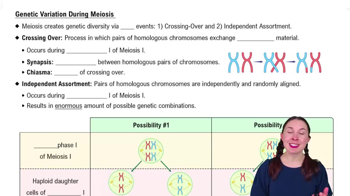
Synapsis is the pairing of homologous chromosomes during meiosis, where each chromosome attaches to its corresponding homologous chromosome forming a tetrad (group of 4 sister chromatids).
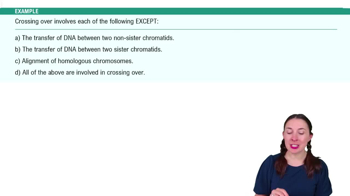
Crossing over exchanges DNA segments between paired homologous chromosomes during meiosis, creating new combinations of alleles and increasing genetic variation.
Homologous chromosomes are the two copies of a single chromosome found in each somatic cell, one from each parent.
Alleles are different versions of the same gene located on each chromosome.
DNA is replicated and chromatin exists as long, uncondensed strands preparing the cell for meiosis.
Chromosomes condense, homologous pairs form tetrads, and the nuclear envelope breaks down.
Homologous chromosome pairs line up side by side along the metaphase plate.
Homologous chromosomes separate to opposite poles, but sister chromatids remain attached.
The nuclear envelope reforms and the cell divides into two haploid cells containing duplicated chromosomes.
New spindle fibers form in each haploid cell and the nuclear envelope breaks down.
Chromosomes in each haploid cell line up at the metaphase plate.
Sister chromatids separate and are pulled to opposite poles of the cell.
The nuclear envelope reforms and the cells divide, producing four haploid daughter cells.
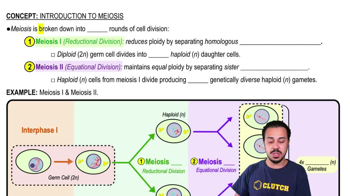
Daughter cells are haploid, containing half the chromosome number of the original diploid cell.
A tetrad is a group of four sister chromatids formed when homologous chromosomes pair during synapsis.
Meiosis reduces chromosome number by half and introduces genetic variation, essential for producing genetically diverse gametes.
Meiosis produces four haploid daughter cells from one diploid parent cell.
Sister chromatids remain attached while homologous chromosomes separate.
DNA replication ensures each chromosome consists of two sister chromatids before meiosis begins.
During metaphase 1 of meiosis.