 Back
Meiosis, Genetics, and Histology Basics
 1:06

Terms in this set (20)
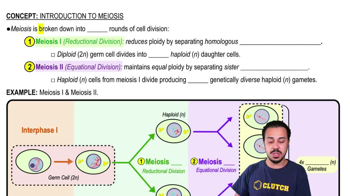
Meiosis is a type of cell division that reduces the chromosome number by half, producing four genetically unique haploid cells.
Meiosis produces gametes (sperm and eggs) for sexual reproduction, ensuring genetic diversity.
Meiosis I separates homologous chromosomes; Meiosis II separates sister chromatids.
A gene is a segment of DNA that codes for a specific protein or trait.
Genotype is the genetic makeup; phenotype is the observable trait resulting from the genotype and environment.
Histology is the study of the microscopic structure of tissues.
Epithelial, connective, muscle, and nervous tissues.
Epithelial tissue covers body surfaces and lines cavities, providing protection and absorption.
Connective tissue supports, binds, and protects organs and other tissues.
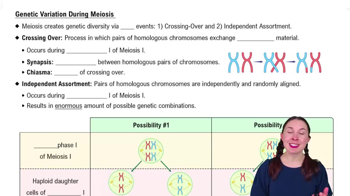
Genetic variation refers to differences in DNA sequences among individuals, contributing to diversity.
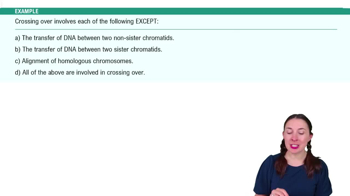
Crossing over is the exchange of genetic material between homologous chromosomes during meiosis I, increasing variation.
Homologous chromosomes are pairs of chromosomes, one from each parent, that have the same genes but possibly different alleles.
Haploid cells have one set of chromosomes (n); diploid cells have two sets (2n).
The chromosome number halves during meiosis I, specifically after anaphase I.
An allele is a variant form of a gene at a specific locus.
Muscle tissue enables movement through contraction.
Nervous tissue transmits electrical signals for communication within the body.
A genotype ratio shows the proportion of different genotypes in offspring from a genetic cross.
A phenotype ratio shows the proportion of observable traits in offspring from a genetic cross.
Histological staining enhances tissue contrast to identify structures under a microscope.