 Back
BackMembrane Dynamics and Transport in Anatomy & Physiology Ch.5
 02:44
02:44
Terms in this set (20)
Osmolarity describes the total number of solute particles in a solution, affecting water movement across membranes.
Osmotic pressure is the pressure required to stop water movement by osmosis across a membrane.
Tonicity describes how a solution affects cell volume: isotonic (no volume change), hypotonic (cell swells), hypertonic (cell shrinks).
Molarity is moles of solute per liter; osmolarity counts total solute particles, including dissociated ions.
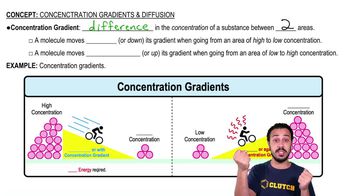
A concentration gradient causes molecules to move from high to low concentration, driving passive transport.
Membrane potential is the electrical charge difference across a membrane, influencing ion movement by electrical driving forces.
The electrochemical driving force combines chemical concentration and electrical forces to determine ion movement direction.
Passive transport moves substances down their gradient without energy; active transport moves substances against their gradient using energy.
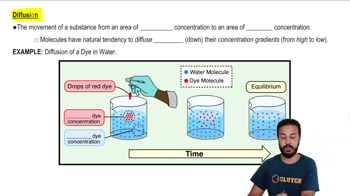
Diffusion is passive, moves molecules from high to low concentration, reaches equilibrium, is faster over short distances, increases with temperature, decreases with molecular size, and occurs across membranes or open systems.
Rate depends on molecule lipid solubility, membrane surface area, concentration gradient, and membrane thickness.
Membrane proteins function as structural proteins, enzymes, receptors, and transport proteins.
Channels form open pores for ions or water; carriers bind and change shape to transport specific molecules.
Gated channels open or close in response to signals; open channels are usually always open.
Facilitated diffusion uses carrier proteins to move molecules down their concentration gradient without energy.
Transport rate saturates because carriers have a limited number and binding sites, causing a maximum flux.
Primary active transport uses ATP hydrolysis to move substances against their gradient, e.g., Na+/K+ pump.
Secondary active transport uses energy from an ion moving down its gradient to transport another substance against its gradient.
Rate depends on the number of pumps and the transport rate of individual pumps.
Endocytosis forms vesicles to bring substances into cells; types include pinocytosis, receptor-mediated, and phagocytosis.
Exocytosis releases large molecules from cells by vesicle fusion with the membrane, opposite of endocytosis.