 Back
BackMuscle Tissue and Contraction - Anatomy & Physiology
 6:31
6:31
Terms in this set (23)
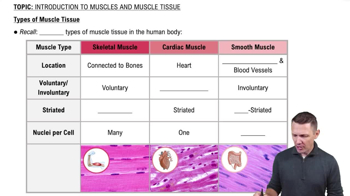
Striated muscle has a striped appearance due to the arrangement of actin and myosin filaments.
Calcium ions (Ca²⁺) trigger muscle contraction by binding to troponin, exposing myosin-binding sites on actin.
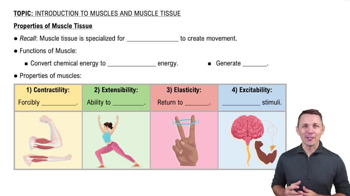
Excitability, the need for ATP, and elasticity are common properties of skeletal, cardiac, and smooth muscle tissues.
Myofibril, muscle fiber, fascicle, muscle is the correct order of muscle organization.
Depolarization means the inside of the sarcolemma becomes less negative as sodium ions enter the cell.
Tropomyosin blocks myosin-binding sites on actin when the muscle is relaxed.
Binding sites on actin open when calcium ions bind to troponin, causing tropomyosin to move.
The muscle fiber cell membrane is called the sarcolemma.
Muscle relaxation occurs when calcium ions are actively transported back into the sarcoplasmic reticulum.
The cross-bridge detaches when ATP binds to the myosin head, allowing it to release actin.
Thin and thick filaments are organized into functional units called sarcomeres.
Tension is greatest during the contraction phase of a muscle twitch.
Muscle fatigue is caused by exhaustion of energy reserves and buildup of lactic acid.
Sprinters fatigue sooner due to anaerobic metabolism producing lactic acid faster.
Creatine phosphate supplies energy through high-energy phosphate bonds that regenerate ATP quickly.
Muscle cells will use glycogen as an alternative energy source when ATP regeneration is blocked.
Sprinters typically have about 50% fast-twitch and 50% slow-twitch muscle fibers.
Marathon runners usually have about 40% fast-twitch and 60% slow-twitch muscle fibers.
Fast fibers have a large diameter and densely packed myofibrils, enabling rapid contractions.
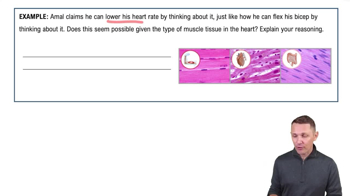
Cardiac muscles are striated and use aerobic metabolism, unlike some skeletal muscle fibers.
Smooth muscle is involuntary and lacks striations, differing from skeletal and cardiac muscle.
Muscle tissue develops from myoblast cells during embryonic development.
Satellite cells help repair and regenerate injured muscle fibers.