 Back
Muscle Tissue and Contraction in Anatomy & Physiology
 6:31

Terms in this set (24)
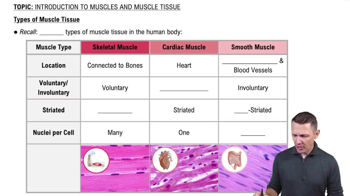
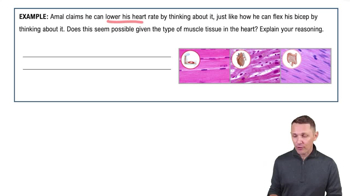
Skeletal: voluntary, striated, multinucleated; Cardiac: involuntary, striated, branched, intercalated discs; Smooth: involuntary, non-striated, spindle-shaped cells.
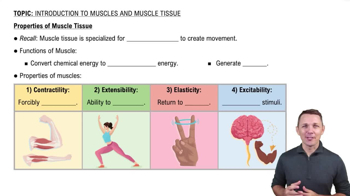
Movement, posture maintenance, joint stabilization, and heat generation.
Composed of muscle fibers bundled into fascicles, surrounded by connective tissues: endomysium, perimysium, and epimysium.
Myofibrils are rod-like units within muscle fibers containing repeating sarcomeres, the contractile units made of actin and myosin filaments.
The sarcoplasmic reticulum stores and releases calcium ions essential for muscle contraction.
T tubules conduct electrical impulses deep into the muscle fiber to trigger calcium release from the sarcoplasmic reticulum.
Actin filaments slide over myosin filaments, shortening sarcomeres and contracting the muscle.
Motor neuron releases acetylcholine, which binds to receptors on the muscle fiber, triggering an action potential.
Action potential travels along T tubules, causing calcium release from sarcoplasmic reticulum, enabling cross bridge formation.
Cross bridge formation, power stroke, detachment, and re-cocking of myosin head using ATP.
A motor neuron and all the muscle fibers it innervates.
A single muscle fiber contraction with phases: latent (delay), contraction, and relaxation.
By varying the number of motor units activated and their firing frequency.
Isometric: muscle tension without length change; Isotonic: muscle changes length with constant tension.
Creatine phosphate, anaerobic glycolysis, and aerobic respiration.
EPOC: excess post-exercise oxygen consumption; fatigue: decline in muscle's ability to generate force.
ATP depletion, lactic acid buildup, ionic imbalances, and central nervous system fatigue.
Aerobic: increases endurance and mitochondria; resistance: increases muscle size and strength.
Prime movers produce main movement; antagonists oppose; synergists assist prime movers.
Muscle location determines the direction and type of movement it produces at the joint.
Location, shape, size, direction of fibers, number of origins, origin/insertion, and action (e.g., biceps brachii).
Parallel (speed), pennate (power), convergent, circular; pennate generate more force.
A lever is a rigid bar that moves on a fulcrum; mechanical advantage means less effort needed to move a load.
First-class: fulcrum between effort and load; second-class: load between fulcrum and effort; third-class: effort between fulcrum and load.