Skip to main content
Anatomy & Physiology
My Course
Learn
Exam Prep
AI Tutor
Study Guides
Textbook Solutions
Flashcards
Explore
Try the app
My Course
Learn
Exam Prep
AI Tutor
Study Guides
Textbook Solutions
Flashcards
Explore
Try the app
Back
Muscle Tissue and Skeletal Muscle Structure - Anatomy & Physiology
You can tap to flip the card.
What are the three types of muscle tissue?
You can tap to flip the card.
👆
What are the three types of muscle tissue?
Skeletal
,
Cardiac
, and
Smooth
muscle.
Track progress
Control buttons has been changed to "navigation" mode.
1/20
Recommended videos
Guided course
6:31
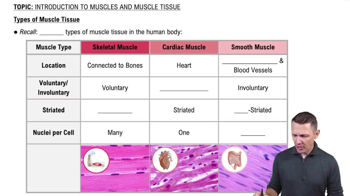
Types of Muscle Tissue
18701
views
494
rank
1
comments
Guided course
2:00
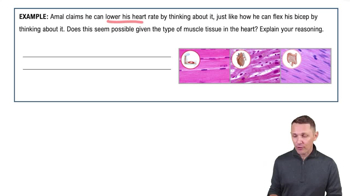
Introduction to Muscles and Muscle Tissue Example 1
16629
views
323
rank
Guided course
4:36
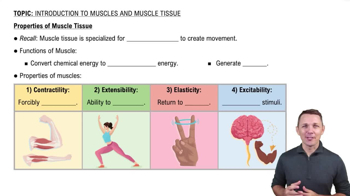
Properties of Muscle Tissue
25592
views
741
rank
2
comments
Terms in this set (20)
Hide definitions
What are the three types of muscle tissue?
Skeletal
,
Cardiac
, and
Smooth
muscle.
What prefixes are commonly used for muscle-related terms?
Myo
,
mys
, and
sarco
.
Describe skeletal muscle tissue characteristics.
Attached to bones or skin, long cylindrical multinucleate cells, striated, voluntary, contract rapidly but tire easily.
Where is cardiac muscle found and what are its key features?
Only in the heart walls, striated, involuntary, can contract without nervous system stimulation.
What are the characteristics of smooth muscle tissue?
Found in walls of hollow organs, non-striated, involuntary, can contract without nervous system stimulation.
What are the four special characteristics of muscle tissue?
Excitability
,
Contractility
,
Extensibility
, and
Elasticity
.
List four important functions of muscle tissue.
Movement of bones or fluids, maintaining posture, stabilizing joints, and heat generation.
What connective tissue sheaths surround skeletal muscle from outer to inner?
Epimysium
surrounds entire muscle,
Perimysium
surrounds fascicles,
Endomysium
surrounds individual muscle fibers.
Define origin and insertion in skeletal muscle attachment.
Origin
is the immovable bone attachment;
Insertion
is the movable bone attachment.
What is a sarcomere?
The smallest contractile unit of a muscle fiber, composed of thick and thin myofilaments between two Z discs.
What proteins compose thick and thin filaments in muscle fibers?
Thick filaments are made of
myosin
; thin filaments are made of
actin
,
tropomyosin
, and
troponin
.
What is the role of titin in muscle fibers?
An elastic filament that holds thick filaments in place, helps recoil after stretch, and resists excessive stretching.
What is the sarcoplasmic reticulum's function in muscle fibers?
Stores and releases
Ca2+
ions to regulate muscle contraction.
What are T tubules and their function?
Extensions of the sarcolemma that penetrate the muscle fiber, conducting impulses deep into the cell.
Explain the sliding filament model of muscle contraction.
Thin filaments slide past thick filaments, increasing overlap and shortening the sarcomere, causing muscle contraction.
What happens to the sarcomere bands during contraction?
I bands
shorten,
H zones
disappear,
Z discs
move closer, while
A bands
stay the same length.
How do myosin heads contribute to muscle contraction?
They bind to actin forming cross bridges, then pivot to pull thin filaments toward the sarcomere center.
What is the difference in cell shape between skeletal, cardiac, and smooth muscle?
Skeletal: long cylindrical; Cardiac: branching chains; Smooth: spindle-shaped, uninucleate.
How is contraction regulated differently in skeletal, cardiac, and smooth muscle?
Skeletal: voluntary via somatic nervous system; Cardiac: involuntary via intrinsic system; Smooth: involuntary via autonomic nerves and hormones.
What is the source of calcium for contraction in skeletal, cardiac, and smooth muscle?
Skeletal: sarcoplasmic reticulum; Cardiac and smooth: sarcoplasmic reticulum and extracellular fluid.
 BackBack
 6:31