 Back
Muscle Tissue and Skeletal Muscle Structure Chapter 9
 6:31

Terms in this set (20)
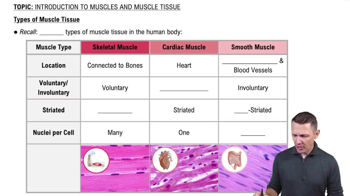
Skeletal, Cardiac, and Smooth muscle tissues.
Attached to bones/skin, elongated multinucleate fibers, striated, voluntary, contracts rapidly, requires nervous system stimulation.
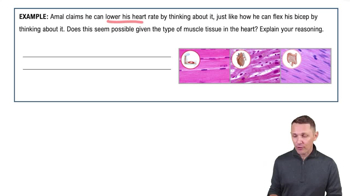
Found only in heart walls, striated, involuntary, can contract without nervous system stimulation, branched cells with intercalated discs.
Located in walls of hollow organs, non-striated, involuntary, can contract without nervous system stimulation, spindle-shaped cells.
Epimysium surrounds entire muscle, Perimysium surrounds fascicles, Endomysium surrounds individual muscle fibers.
Direct attachment: epimysium fused to bone periosteum. Indirect attachment: connective tissue extends as tendon or aponeurosis.
Long cylindrical cell with multiple peripheral nuclei, sarcolemma (plasma membrane), sarcoplasm (cytoplasm), contains myofibrils, sarcoplasmic reticulum, and T tubules.
Densely packed rodlike elements making up ~80% of cell volume, containing sarcomeres which are contractile units composed of myofilaments.
The smallest contractile unit of a muscle fiber, extending from one Z disc to the next, composed of thick and thin myofilaments.
Thick filaments are made of myosin, thin filaments are made of actin, with regulatory proteins tropomyosin and troponin.
Titin is an elastic filament that holds thick filaments in place, helps recoil after stretch, and resists excessive stretching.
Network of smooth ER surrounding myofibrils, stores and releases calcium ions (Ca2+) to regulate contraction.
Extensions of the sarcolemma that penetrate the muscle fiber, conducting impulses deep into the fiber to trigger calcium release from the SR.
A structure formed by a T tubule flanked by two terminal cisterns of the sarcoplasmic reticulum, important for excitation-contraction coupling.
During contraction, thin filaments slide past thick filaments, increasing actin-myosin overlap, shortening the sarcomere and muscle fiber.
I bands shorten, Z discs move closer, H zones disappear, A bands stay the same length.
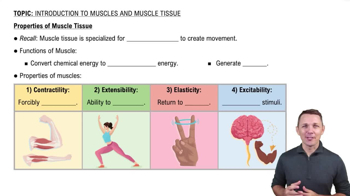
Excitability (respond to stimuli), Contractility (shorten forcibly), Extensibility (stretch), Elasticity (recoil to resting length).
Movement of bones/fluids, maintaining posture, stabilizing joints, heat generation.
Links thin filaments to proteins of the sarcolemma, helping maintain muscle fiber integrity.
Each muscle is served by one artery, one nerve, and one or more veins that branch through connective tissue sheaths.