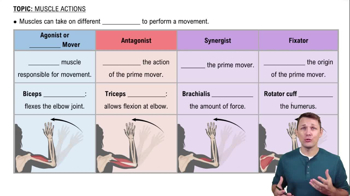
What are the three main functional groups of muscles?
Prime mover (agonist): major responsibility for movement; Antagonist: opposes movement; Synergist: assists prime mover and stabilizes.
What is the role of a fixator muscle?
A type of synergist that immobilizes the bone or muscle origin to provide a stable base for the prime mover.
How can the action of a muscle be inferred?
By the position of the muscle relative to the joint it crosses (anterior side produces flexion, posterior side extension, lateral side abduction, medial side adduction).
What are the criteria used for naming skeletal muscles?
Location, shape, size, direction of fibers, number of origins, location of attachments, and muscle action.
Give an example of muscle named by shape and by number of origins.
Shape: deltoid (triangle); Number of origins: biceps (two origins), triceps (three origins).
What are the common fascicle arrangements in skeletal muscles?
Describe the circular fascicle arrangement and give an example.
Fascicles arranged in concentric rings; example: orbicularis oris.
What is a convergent muscle fascicle arrangement?
Broad origin with fascicles converging toward a single tendon; example: pectoralis major.
Describe parallel and fusiform fascicle arrangements.
Parallel: fascicles run parallel to long axis (example: sartorius); Fusiform: spindle-shaped with parallel fibers (example: biceps brachii).
What distinguishes pennate muscles and their types?
Short fascicles attach obliquely to tendon; types: unipennate (one side), bipennate (both sides), multipennate (feather-like).
How do fascicle arrangements affect muscle function?
Fascicles determine range of motion and power; long parallel fibers shorten more but are less powerful; pennate muscles have more fibers, are powerful but shorten less.
What are the muscles of facial expression innervated by?
All are innervated by cranial nerve VII (facial nerve).
Name two muscles of mastication and their innervation.
Masseter and temporalis; both innervated by cranial nerve V (trigeminal nerve).
What muscles are involved in inspiration?
Diaphragm and external intercostals; they enlarge the rib cage during inhalation.
Which muscles are responsible for forced expiration?
Internal intercostals and relaxation of inspiratory muscles decrease rib cage size.
List the four paired muscles of the abdominal wall.
 Back
Back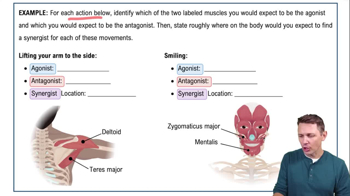
 3:55
3:55