 Back
Muscular System - Anatomy & Physiology
 6:31

Terms in this set (22)
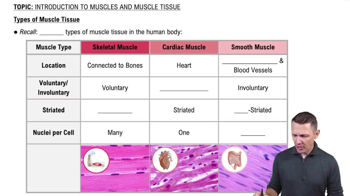
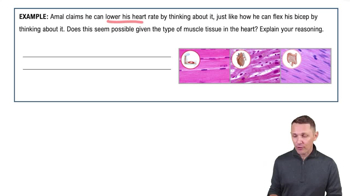
Skeletal muscle is voluntary and attached to bones, cardiac muscle is involuntary and found in the heart, and smooth muscle is involuntary and found in walls of hollow organs.
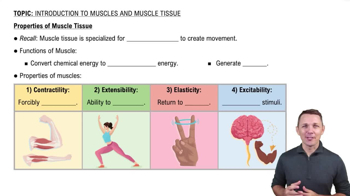
The muscular system consists of all the muscles in the body that enable movement, maintain posture, and produce heat.
Endomysium surrounds individual muscle fibers, perimysium surrounds bundles of fibers called fascicles, and epimysium surrounds the entire muscle.
Tendons connect muscle to bone, while aponeuroses are broad, flat sheets of connective tissue that also attach muscles to bones or other muscles.
Skeletal muscle fibers contain myofibrils made of actin (thin) and myosin (thick) myofilaments responsible for contraction.
An action potential is initiated when a motor neuron releases acetylcholine, triggering depolarization of the muscle cell membrane.
Contraction involves calcium release, cross-bridge formation between actin and myosin, and ATP powered sliding of filaments.
A graded response is the varying strength of muscle contraction depending on stimulus frequency and intensity.
Tetanus is a sustained muscle contraction caused by rapid repeated stimuli without relaxation.
Isotonic contractions change muscle length with movement; isometric contractions generate tension without changing length.
Muscle tone is the continuous, partial contraction of muscles to maintain posture and readiness.
ATP is regenerated by direct phosphorylation, anaerobic glycolysis, and aerobic respiration.
Oxygen deficit is the extra oxygen needed after exercise to restore normal conditions; muscle fatigue is the inability to contract due to ATP depletion or lactic acid buildup.
Causes include ATP depletion, lactic acid accumulation, ionic imbalances, and reduced neural stimulation.
Aerobic exercise increases muscle endurance by enhancing oxygen delivery and mitochondrial efficiency.
Resistance exercise increases muscle size and strength by promoting muscle fiber hypertrophy.
Origin is the fixed attachment point of a muscle; insertion is the movable attachment point.
Prime mover causes main movement; antagonist opposes it; synergist assists; fixator stabilizes origin.
Muscles are named by location, shape, size, direction of fibers, number of origins, location of attachments, and action.
Nerve supply is essential for muscle contraction and maintaining muscle tone and health.
Exercise improves muscle strength, endurance, and prevents atrophy by stimulating muscle fibers and blood flow.
Aging muscles show decreased mass, strength, and flexibility, with increased fatigue and slower repair.